Your Cold Store Doorway Could Be the Weakest Link in Your Frozen Food Operation.
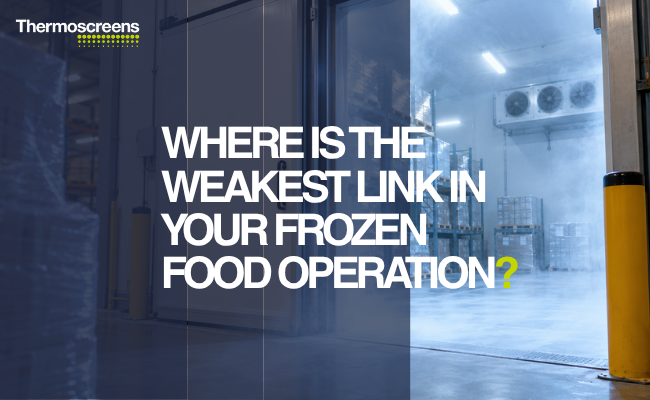
Walk any frozen food warehouse floor and the compressors get all the attention — the humming plant room, the defrost schedules, the refrigerant charge. But the single biggest hole in the building envelope is usually somewhere much simpler: the doorway. Every time it opens, warm, humid air pours into a space that’s been engineered and paid for to stay cold, and the refrigeration plant has to work harder to claw that temperature back.
For operators running frozen food storage, distribution, or retail cold rooms, the doorway isn’t a minor detail. It’s frequently the single largest avoidable source of energy loss, ice build-up, and product-quality risk in the whole facility — and it’s often the last thing anyone specifies properly. This article looks at why the cold store doorway deserves as much engineering attention as the refrigeration plant itself, what a cold storage air curtain actually does about it, and how to work out whether upgrading yours will pay for itself.
What’s Actually Leaking Through Your Cold Store Doorway?
Every open doorway between a refrigerated space and the outside world (or an ambient corridor) creates what refrigeration engineers call infiltration: warm, moisture-laden air moving into the cold zone to replace the cold air falling out at floor level. This isn’t a trivial side effect — refrigeration compressors typically account for 70–80% of total energy use in a cold storage facility, and infiltration through doorways is one of the largest single drivers of that compressor workload, alongside product loading and defrost cycles.
The scale of the problem is easy to underestimate. Cold room door loss audits commonly find that door loss accounts for 20–35% of total refrigeration load in high-traffic cold rooms, a figure that climbs further as door seals degrade or closers fail and doors are left ajar for longer. Even short lapses add up fast: analysis from door automation specialist LiftMaster estimates a warehouse can lose over $1,100 a year in wasted energy from a door left open just one extra minute per day — and over $5,400 a year at five extra minutes.
Every one of those minutes also brings condensation, ice, and frost — a safety and maintenance problem as much as an energy one. So before looking at fixes, it’s worth being precise about what an open cold store doorway is actually costing an operation:
- Direct refrigeration energy spent re-cooling infiltrated warm air
- Compressor wear and demand charges, since infiltration spikes push plant beyond its efficient operating band
- Ice and frost build-up around the doorway, floor, and nearby evaporators, creating slip hazards and forcing costly de-icing downtime
- Product quality risk, from temperature excursions on stock stored or staged near the doorway
- Defrost frequency, which itself consumes energy and further increases downtime
How Much Does an Open Cold Store Door Really Cost You?
This is the question every operations or facilities manager should be asking before they accept doorway losses as “just the cost of doing business.” The honest answer is: it depends on four variables, all of which are measurable on your own site.
- Temperature differential between the cold store and the adjoining space — the bigger the gap, the more energy each infiltration event costs.
- Door traffic frequency — how many times per shift the doorway opens, and for how long each time.
- Energy unit cost (£/kWh), which has become significantly more material to the payback calculation since 2022.
- Refrigeration system efficiency — a less efficient plant amplifies every kWh of avoidable loss.
A simple cold storage door energy audit — tracking door open-time, compressor run-time, and defrost frequency via building management system (BMS) data — turns these variables from guesswork into a business case. Facilities running doors for more than 1,000 hours a year tend to see the fastest returns from fixing the doorway first, because that’s where the compounding losses are concentrated.
Why Traditional Doorway Solutions Fall Short
Two legacy approaches dominate cold storage doorways, and both come with trade-offs that matter more in frozen food operations than they might first appear.
Insulated doors reduce conductive heat loss when closed, but they do nothing for the seconds — or minutes — a doorway is open for forklift or pedestrian traffic. In a facility cycling a doorway hundreds, or in 24/7 operations over a thousand times a day, that “open” window is where most of the damage happens.
PVC strip curtains are cheap to install and food-safe when specified correctly, but they make direct physical contact with goods, forklifts, and staff. That contact creates a recognised hygiene risk — grease, residue, and moisture build-up on the strips — and a dedicated cleaning regime is needed to keep them compliant. Strips also obstruct traffic flow, degrade with wear, and stiffen or crack in sub-zero conditions, undermining the very seal they’re meant to provide.
Neither solution addresses the physics of the problem directly: stopping air movement at the doorway itself, without physically blocking the opening.
How Does an Air Curtain Work in a Cold Storage Doorway?
A cold storage air curtain creates an invisible, high-velocity band of recirculated air across the full width and height of a doorway. Positioned correctly, that air stream forms a barrier that resists the natural pressure difference driving warm air in and cold air out — without a single moving part obstructing the opening itself.
Because it’s contact-free, an air curtain solves the hygiene and traffic-flow problems that strip curtains create, while addressing the exact failure point insulated doors can’t: the open-door interval. Independent testing on doorway air control reports infiltration reductions in the region of 60–80% compared with an unprotected opening — figures that align with the industry’s growing use of BS EN 16798, the European standard covering ventilation and infiltration airflow calculation methods, as the reference framework for specifying doorway air control credibly.
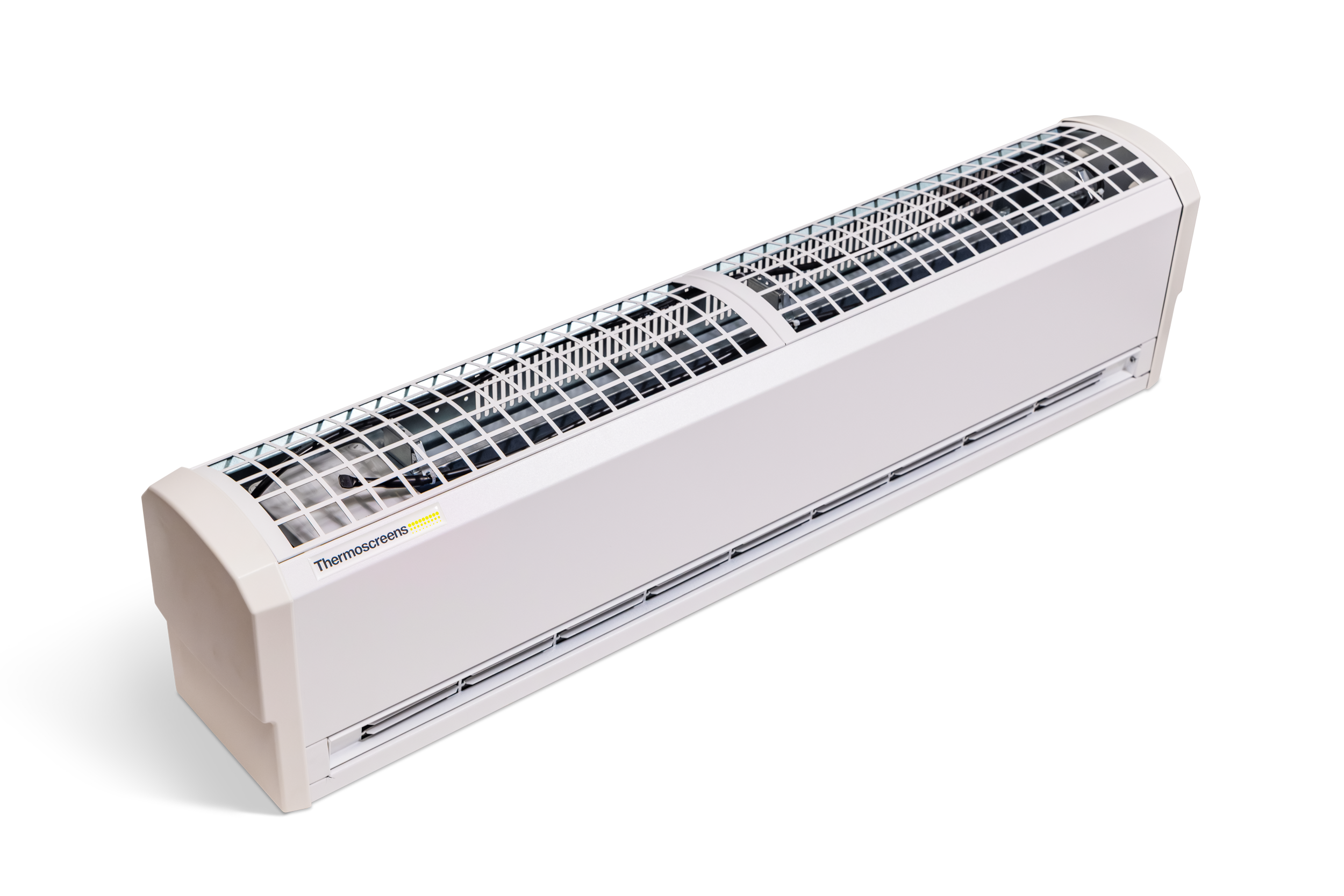
Cold-chain-specific units differ meaningfully from standard commercial entrance air curtains, which are built for retail shopfronts and aren’t rated for sustained sub-zero performance. Purpose-built cold store air curtains, such as Thermoscreens’ CS range, use advanced EC motor technology to maintain climate separation reliably down to -25°C, with door-switch control that ramps fan speed up when the door opens and down — or off — once it’s closed, and built-in anti-frost protection to keep the unit itself operating in extreme cold.
What Is the ROI of a Cold Storage Air Curtain?
For most operators, this is the question that actually drives the purchasing decision — and it deserves a specific, evidence-based answer rather than a generic promise of “energy savings.”
Thermoscreens’ own monitored case study on a live cold storage installation recorded weekly energy usage falling from 3,346 kWh to 2,846 kWh after fitting an HE air curtain — a measurable, repeatable saving rather than a modelled estimate. The full breakdown, including weekly cost savings and payback period, is set out in Do Air Curtains Actually Pay for Themselves? Real ROI Data Explained.
Across typical UK cold storage and retail cold room conditions, most air curtain installations achieve payback within one to three years, with continued energy and product-quality savings for the life of the unit thereafter. The ROI calculation should combine:
- Avoided refrigeration energy (the largest component)
- Reduced defrost cycle frequency
- Lower product spoilage from temperature excursions
- Reduced maintenance and safety-incident costs from ice and frost around the doorway
Because refrigeration is the dominant energy cost in almost every cold store, even a partial reduction in infiltration load tends to move the payback clock forward significantly. A site-specific calculation — not a generic percentage — is the only reliable way to size the business case, which is why Thermoscreens offers a free site survey ahead of specification.
Choosing the Right Air Curtain for Your Cold Store
Not every cold store doorway is the same, and specifying the wrong unit undermines the whole business case. Key factors to work through with a technical specialist include:
- Operating temperature. Standard commercial units aren’t rated for sustained frozen conditions; look for units proven down to -25°C.
- Headspace above the door. Many retail and older industrial cold stores have limited clearance. Thermoscreens’ Slimline CS Air Curtain was engineered specifically for these compact installations, delivering the same climate-separation performance as the standard CS unit in a reduced footprint.
- Door width and traffic type — pedestrian, forklift, or mixed traffic all change the required air volume and velocity.
- Humidity levels, which affect frost and ice formation risk around the unit and doorway.
- Integration with BMS, allowing door-switch control and centralised monitoring of run-time and performance data.
Getting these variables right is the difference between an air curtain that pays for itself in a year and one that underperforms because it was treated as an off-the-shelf commodity rather than an engineered specification.
Beyond Energy: Safety, Compliance and Product Quality
Energy savings tend to dominate the conversation, but doorway performance touches three other areas that matter just as much to a frozen food operation:
- Workplace safety. Ice build-up around a cold store doorway is a recognised slip hazard and a leading contributor to cold room maintenance call-outs. Reducing infiltration reduces ice formation at the source.
- Product integrity and food safety. Temperature excursions near doorways can compromise stock quality and, in regulated environments, create compliance exposure.
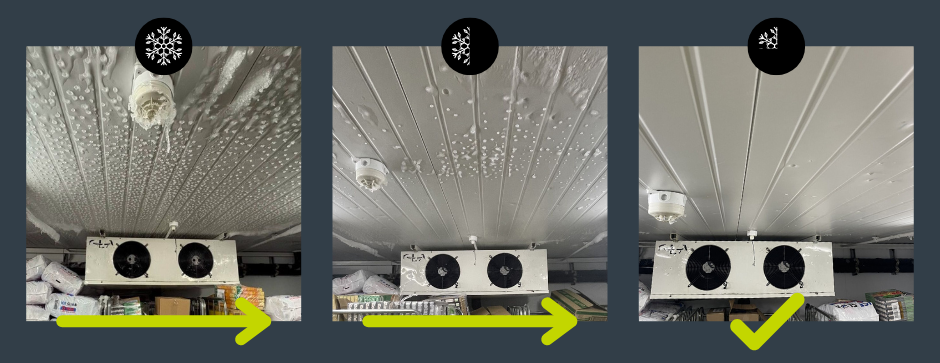
- Operational uptime. Every hour spent de-icing a doorway or nearby evaporator is an hour of reduced throughput. One Thermoscreens retail cold store case study recorded the effective elimination of ice and frost build-up around the room, including on the evaporators themselves, after installing a purpose-built cold store air curtain — see Enhancing Efficiency and Safety with Thermoscreens Cold Store Air Curtain.
Case in Point: A Supermarket Cold Store
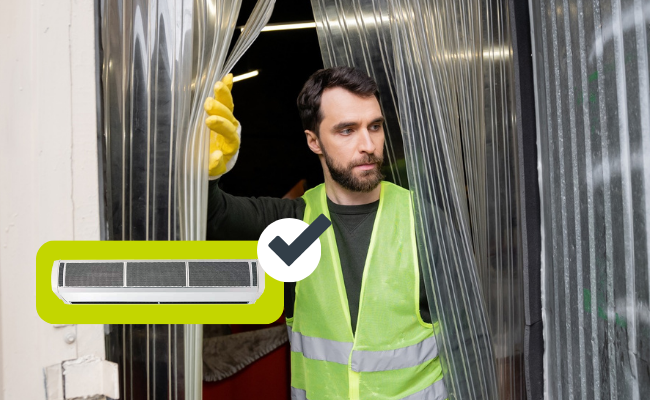
A UK supermarket operator installed a Thermoscreens CS Air Curtain above a high-traffic cold store entrance after frequent door openings were forcing chillers and compressors to work significantly harder to hold temperature. The result was a stable refrigerated environment, reduced ice build-up, and measurable improvements in refrigeration efficiency — outcomes the client described as transforming both safety and day-to-day operations. Similar patterns are documented across Thermoscreens’ cold-chain case studies, including installations for brewery cold storage, cruise ship cold rooms, and airline catering, each with its own temperature differential, traffic pattern, and payback profile.
Frequently Asked Questions
Does my cold store doorway really need an air curtain if the door has good seals?
Yes. Door seals only help while the door is closed. Every time it opens for traffic, seals are irrelevant — and in high-traffic cold stores, that’s where the majority of infiltration and energy loss actually happens. An air curtain addresses the open-door interval that seals can’t.
What’s the difference between an air curtain and a strip curtain for cold storage?
An air curtain uses a recirculated air barrier and never physically touches product, forklifts, or staff, avoiding the hygiene and wear issues associated with PVC strip curtains. Strip curtains are lower-cost initially but require dedicated cleaning schedules and can obstruct traffic flow; the two approaches can also be combined on some sites.
How cold can a cold storage air curtain operate?
Purpose-built cold-chain units, such as Thermoscreens’ CS and Slimline CS ranges, are proven to maintain climate separation reliably at temperatures as low as -25°C — well beyond the rating of standard commercial entrance air curtains.
What is the typical ROI or payback period for a cold storage air curtain?
Most UK cold storage and retail cold room installations achieve payback within one to three years, driven primarily by avoided refrigeration energy, with continued savings on defrost frequency, product spoilage, and maintenance thereafter. Payback is site-specific and depends on temperature differential, traffic frequency, energy cost, and plant efficiency.
Can an air curtain be retrofitted into an existing cold store doorway?
Yes. Air curtains are typically retrofitted above existing doorways without structural alteration, and compact models are available for sites with limited headspace above the door.
How much energy does an open cold store door actually waste?
Industry data suggests door loss can account for 20–35% of total refrigeration load in high-traffic cold rooms, and even short daily lapses — a door left open a few extra minutes — can cost a facility thousands of pounds a year in wasted energy.
Don’t Let the Doorway Undo the Rest of Your Cold Chain
You can specify the most efficient compressors on the market, insulate every wall to the highest standard, and still lose a disproportionate share of your energy budget through one unprotected doorway. For frozen food operators, the cold store doorway isn’t a minor fitting – it’s a control point that deserves the same engineering rigour as the refrigeration plant it protects.
Thermoscreens has spent decades specifying and manufacturing cold-chain air curtains for UK and international operators, from single-site retail cold rooms to 24/7 frozen food distribution centres. If you’re not sure how much your own doorway is costing you, a free, no-obligation site survey is the fastest way to find out – talk to the Thermoscreens technical team about specifying the right cold storage air curtain for your facility.
Testimonials
“We’ve been very pleased with your products and would like to continue using them as a design feature in all our shops.”
- Project Manager, large ice-cream manufacturer.
“Wrapped up and gone before the lunch service, great turnaround from order to delivery.”
- Director, Restaurant in Aldwych
“Thank you for having an excellent working relationship with me, you are a credit to Thermoscreens.”
- Technical Engineer, HVAC
“The new air curtains in the freezer room have completely eliminated any ice and frost build up around the room, including the evaporators. As the main reason for cold room failure, this will undoubtedly help to reduce costly downtime, stock loss and maintenance calls.”
- Refrigeration Manager at leading supermarket
“The units we installed at Birmingham this week. We really enjoyed installing your units and would like to use them moving forward with the other stores.”
- Installer, Restaurant in Birmingham
“I would like to take this opportunity to thank you all for your performance, we have all been very impressed with your response to queries and turnaround of air curtains.”
- Installer, HVAC
“Thank you for all your support. We couldn’t have won this project without your assistance.”
- Senior engineer