Every Open Door Is a Leak: The Business Case for Air Curtains in Cold Storage.

Air curtains for cold storage have moved from a “nice-to-have” to a measurable line item on the balance sheet. In temperature-controlled warehousing, every open doorway is a leak — bleeding conditioned air, driving up refrigeration costs, and inviting frost, fog and slips. For operations managers and facilities leaders weighing capital spend against running costs, the question is no longer whether an industrial air curtain pays for itself, but how quickly. This guide sets out the full business case — the physics, the numbers, the compliance angle and the return on investment – so you can make a confident, evidence-led decision.
Answer-first summary
An air curtain creates an engineered stream of high-velocity air across an opening, forming an invisible barrier that limits the exchange of warm and cold air. In a cold store air curtain application, this can stop a large share of air infiltration through an open doorway, cutting refrigeration energy use, reducing frost and ice build-up, and keeping forklift and pedestrian traffic flowing. Most temperature-controlled sites see payback within months rather than years.
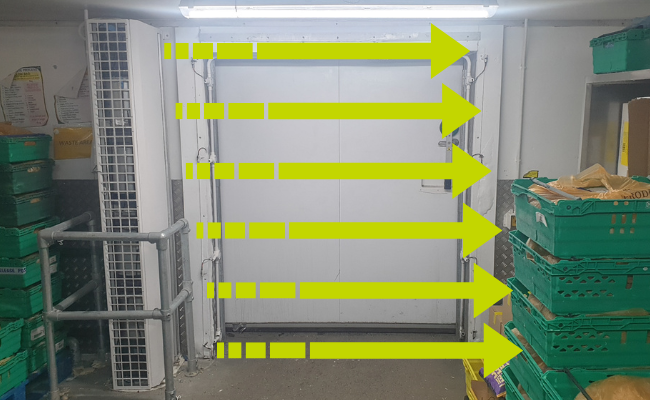
What is an air curtain, and how does it work in a cold store?
An air curtain (also called an air door) is a fan-driven unit mounted above or beside a doorway that discharges a controlled, high-velocity sheet of air across the opening. That moving air stream acts as an aerodynamic barrier, resisting the natural movement of air between two zones at different temperatures.
In temperature-controlled warehousing the problem is not simply heat — it is vapour pressure. When a chilled or frozen room is opened, warm, moisture-laden air rushes in while cold, dry air spills out. That exchange is what produces three expensive symptoms: rising energy bills, frost on evaporator coils, and fog or water pooling at the threshold. As the Air Movement and Control Association (AMCA) explains, this infiltration is driven by the difference in moisture content across the opening, not temperature alone.
A correctly specified cold store air curtain counters that flow. The discharged air is engineered to push back with enough force to oppose the pressure differential, so the doorway can stay open for traffic while the climate barrier stays intact.
Why does this matter for temperature-controlled warehousing right now?
Three pressures are converging on cold-chain operators:
- Energy cost and volatility. Refrigeration is one of the largest energy consumers in a cold store, and open doorways are a direct, continuous source of load.
- Net-zero and ESG reporting. Reducing avoidable energy waste is now a board-level metric, not just a maintenance concern.
- Product integrity and food safety. Temperature excursions and condensation threaten perishable stock and create slip hazards for staff.
Air infiltration through openings can account for a very large share of a refrigerated space’s cooling load — in open refrigerated equipment, studies have attributed roughly 72% of the cooling load to ambient air infiltration. Doorways in a busy warehouse behave the same way: every minute a door stands open is conditioned air paid for and lost.
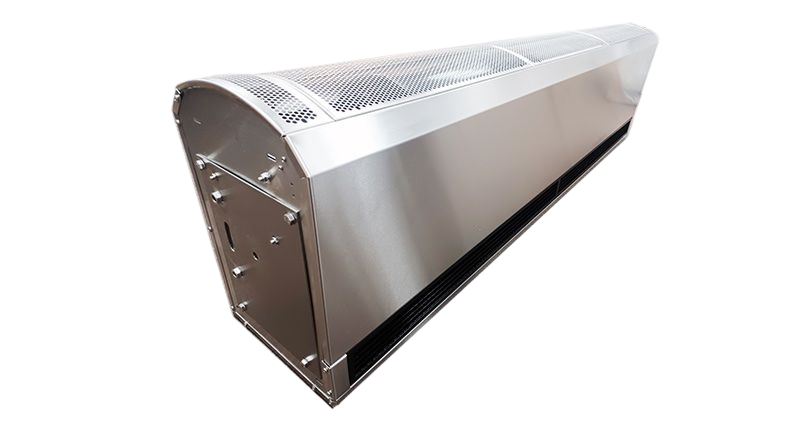
What are the business benefits of an industrial air curtain?
1. Lower refrigeration energy costs
By limiting the volume of warm air entering the cold zone, an industrial air curtain reduces how hard the refrigeration plant has to work to recover setpoint after each door opening. Independent third-party testing of conditioned air-door systems has demonstrated that air-door technology can stop around 80% of air infiltration and energy transfer between rooms at different temperatures, with hybrid door-plus-curtain set-ups reaching 90%+ effectiveness while the opening is in use.
2. Frost, fog and ice prevention
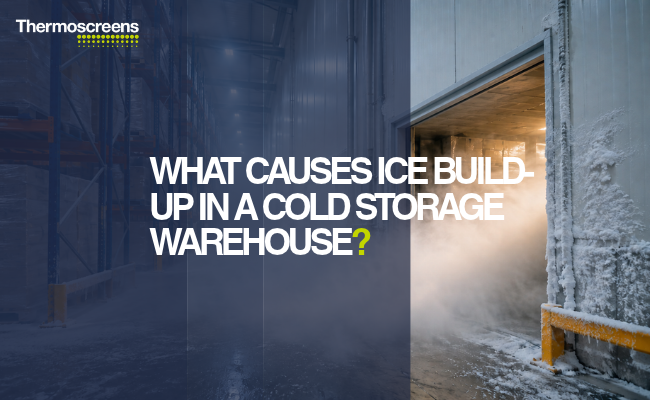
Repeated warm-air ingress forces evaporator coils into frequent defrost cycles, which themselves consume energy and shorten equipment life. Suppressing infiltration with an air curtain helps prevent frost build-up on coils and eliminates the fog and floor condensation that create slip risks at the doorway.
3. Throughput and access
Unlike rapid-roll doors or PVC strip curtains, an air curtain imposes no physical barrier. Forklifts, pallet trucks and pedestrians pass through freely, removing the queuing and handling delays associated with doors that must open and close on every movement.
4. Worker safety and comfort
Reducing cold-air spill into adjacent loading bays and packing areas improves working conditions, while removing standing water and fog at thresholds lowers the risk of slips, trips and falls.
5. Product protection
Stable temperature and humidity protect perishable stock from excursions that lead to spoilage, waste and rejected loads — a direct hit to margin in food, pharmaceutical and cold-chain logistics operations.
Air curtain vs. strip curtain vs. rapid-roll door: which is right?
Each technology has a role, and the strongest installations often combine them. Here is how they compare for a temperature-controlled opening:
| Factor | Air curtain | Strip curtain | Rapid-roll door |
| Traffic flow | Unobstructed | Partial obstruction | Open/close delay |
| Hygiene | No contact surface | Contact, wear, cleaning | Contact surface |
| Visibility | Clear | Reduced | Blocked when closed |
| Best use | High-traffic, doorless or hybrid | Low-traffic, low-cost | Periodic sealing |
For the highest-performing thermal separation, pairing a fast-acting door with an air curtain combines the seal of a closed door with continuous protection while the opening is in use.
What is the ROI of installing air curtains in a cold store?
The return on an air curtain investment comes from four stacked savings: reduced refrigeration energy, fewer defrost cycles, less product spoilage, and lower slip-related incident costs. A simple way to frame the business case for a single opening:
- Estimate the open-door hours. Multiply average daily door-open time by operating days per year.
- Quantify the infiltration load. Work with your refrigeration engineer to value the cooling load lost through that opening.
- Apply the curtain’s effectiveness. Apply a conservative infiltration-reduction figure (well-specified systems block a substantial majority of transfer).
- Add the soft savings. Factor in reduced defrost energy, extended coil life, reduced spoilage and lower safety risk.
Because refrigeration energy is the dominant cost in most cold stores, the energy saving alone frequently delivers payback within months. Energy-efficiency incentive schemes also recognise air curtains and door seals as qualifying measures — some utilities cite heat-loss reductions of up to 90% at protected openings — which can offset capital cost further.
How do you specify the right cold store air curtain?
Under-specify and the barrier fails; over-specify and you add noise, draught and cost. Key parameters to get right:
- Opening height and width. The unit must span the full door width and generate enough velocity to reach the floor.
- Temperature differential. Freezer-to-ambient openings demand far more capacity than chiller-to-chiller.
- Motor efficiency. EC (electronically commutated) motors offer significant energy savings and speed control over older AC motors.
- Mounting and orientation. Vertical (side-mounted) units suit very wide or tall industrial openings; horizontal overdoor units suit standard doorways.
- Controls and integration. Door-activation sensors and building management system (BMS) connectivity ensure the curtain runs only when needed.
Specification should reference recognised methodology. The BS EN 16798 series on the energy performance of buildings sets out calculation methods for ventilation and infiltration air-flow rates that underpin a credible energy case.
Why specify Thermoscreens for temperature-controlled warehousing?
Thermoscreens are pioneers of air curtain technology in Europe, manufacturing commercial and industrial air curtains exported to over 50 countries. The range is engineered specifically for the demands of UK cold-chain and temperature-controlled environments:
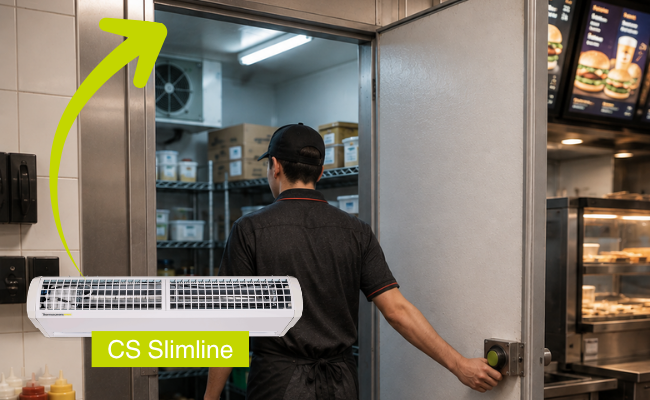
- CS Cold Store Air Curtain — engineered specifically for cold store applications, using advanced EC motor technology to maintain climate separation at temperatures as low as −25°C.
- HX with Ecopower Air Technology — among the most advanced and efficient air-separation solutions available in the UK, combining powerful performance with outstanding energy savings.
- IP Industrial Performance Line — a robust, economical platform for demanding industrial openings, combining sturdy construction with energy-efficient technology.
Thermoscreens operates certified quality and environmental management systems (ISO 9001 and ISO 14001), giving specifiers confidence in both product performance and sustainability credentials.
Frequently asked questions
Do air curtains really save energy in cold storage?
Yes. By limiting warm, humid air from entering the cold zone, a correctly specified cold store air curtain reduces refrigeration load and defrost frequency. Independent testing shows air-door systems can stop around 80% of air infiltration, and energy-efficiency programmes recognise the heat-loss reductions they deliver.
Can an air curtain replace a cold store door entirely?
In many high-traffic settings, yes — air curtains enable doorless climate separation. For maximum performance, however, a hybrid of a fast-acting door plus an air curtain delivers the strongest barrier, sealing when closed and protecting the opening when in use.
What temperature can a cold store air curtain handle?
Industrial cold store units such as the Thermoscreens CS are designed to maintain climate separation at temperatures as low as −25°C, making them suitable for both chilled and frozen applications.
How is air curtain ROI calculated for a warehouse?
ROI combines avoided refrigeration energy, reduced defrost cycles, lower product spoilage and reduced safety incidents, set against the unit and installation cost. Because refrigeration is the dominant energy cost in most cold stores, payback is frequently achieved within the first year.
Air curtain vs strip curtain — which is better for a cold store?
Strip curtains are low-cost but obstruct traffic, wear over time and raise hygiene concerns. Air curtains provide an unobstructed, contact-free barrier ideal for high-traffic, hygiene-sensitive warehousing — though the two can be combined where appropriate.
Ready to build your business case?
Every opening is different, and the strongest business case is built on a site-specific calculation. Thermoscreens’ technical team can size the right industrial air curtain for your temperature-controlled warehouse, model the energy savings, and recommend the optimal configuration for your traffic and temperature profile.
Request a free site assessment and air curtain specification from Thermoscreens today – and turn an open doorway from a cost centre into a measurable saving. Contact the Thermoscreens team →
Testimonials
“We’ve been very pleased with your products and would like to continue using them as a design feature in all our shops.”
- Project Manager, large ice-cream manufacturer.
“Wrapped up and gone before the lunch service, great turnaround from order to delivery.”
- Director, Restaurant in Aldwych
“Thank you for having an excellent working relationship with me, you are a credit to Thermoscreens.”
- Technical Engineer, HVAC
“The new air curtains in the freezer room have completely eliminated any ice and frost build up around the room, including the evaporators. As the main reason for cold room failure, this will undoubtedly help to reduce costly downtime, stock loss and maintenance calls.”
- Refrigeration Manager at leading supermarket
“The units we installed at Birmingham this week. We really enjoyed installing your units and would like to use them moving forward with the other stores.”
- Installer, Restaurant in Birmingham
“I would like to take this opportunity to thank you all for your performance, we have all been very impressed with your response to queries and turnaround of air curtains.”
- Installer, HVAC
“Thank you for all your support. We couldn’t have won this project without your assistance.”
- Senior engineer