Why Brewery Cold Storage Temperature Swings Are Costing You More Than Energy.
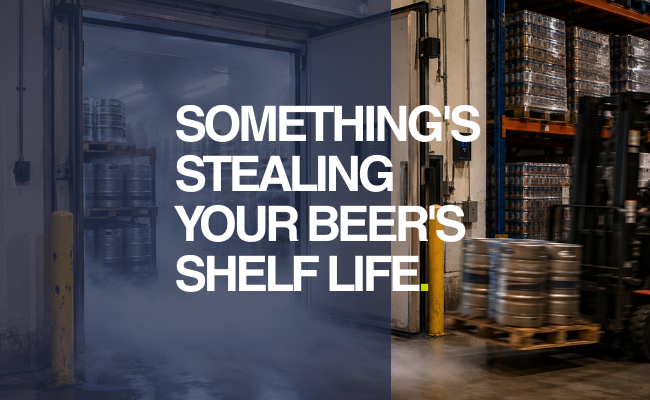
Every brewery cold storage temperature log has a number on the wall: 2°C, 4°C, whatever the SOP says. What that number hides is how often the room actually sits at that temperature versus how often it swings a degree or three either side of it, dozens of times a day, every time a door opens, a forklift passes through, or a defrost cycle kicks in
Those swings are cold store temperature fluctuations, and for a brewery they’re rarely dramatic enough to trigger an alarm, which is exactly why they’re expensive. Unlike a compressor failure or a burst pipe, fluctuation doesn’t announce itself. It shows up months later as a higher electricity bill, a batch of beer that tastes tired before its date code says it should, and a maintenance team fixing the same seal for the third time this year.
This article breaks down where those fluctuations come from, what they actually cost a brewery in energy, product quality, and compliance risk, and what a well-specified door protection strategy, including air curtains – does to bring brewery cold storage temperature performance back under control.
What Causes Temperature Fluctuations in Brewery Cold Stores?
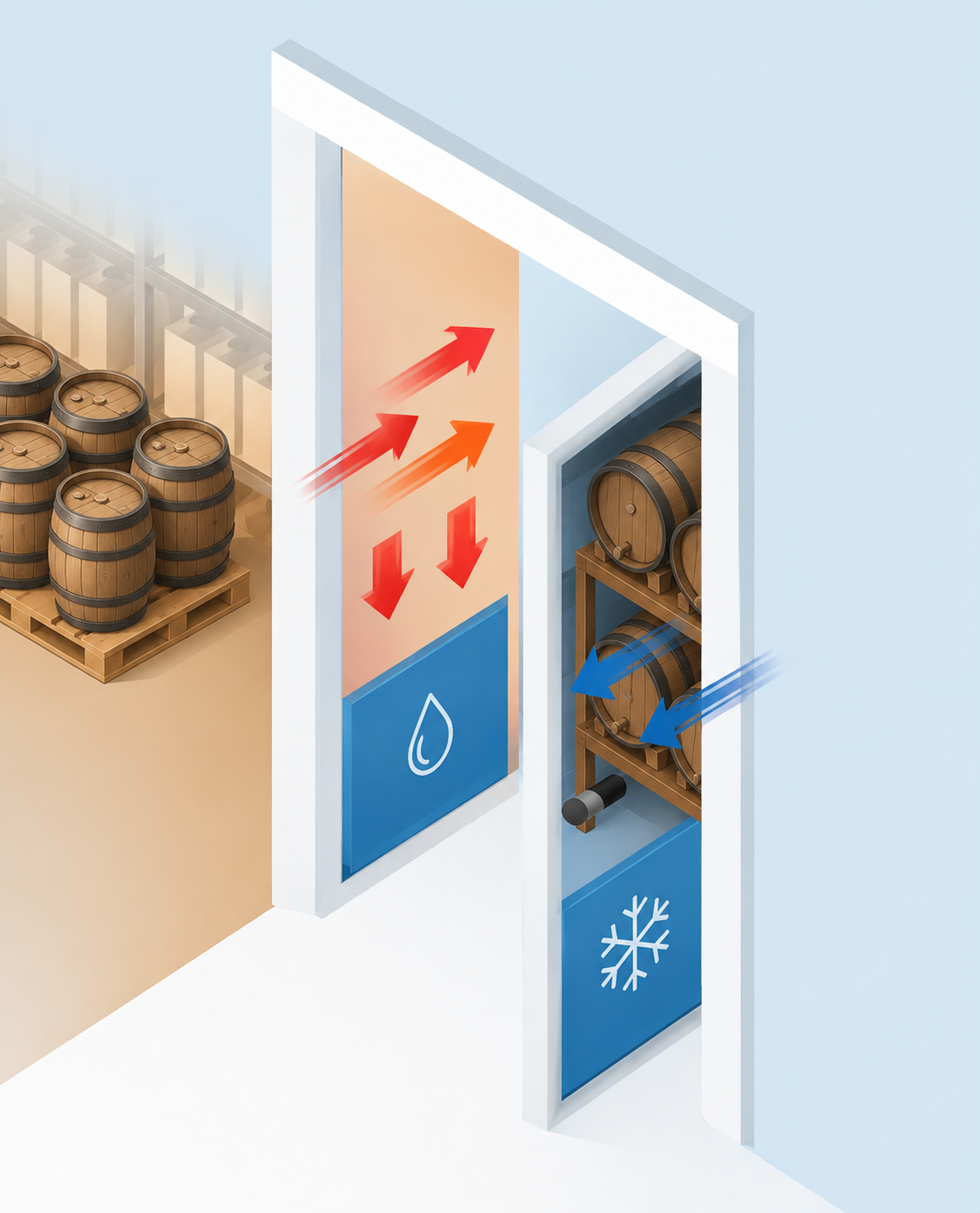
Instability in brewery cold storage temperature almost never comes from the refrigeration plant itself failing. It comes from heat getting in faster than the plant can remove it. In a working brewery, that happens through:
- Door openings. Every time a cold store door opens for a keg run, pallet movement, or staff access, warm, humid ambient air rushes in and displaces the cold air at floor level almost immediately.
- Door dwell time. Doors propped open during busy loading periods do more damage than quick in-and-out trips — the longer the opening, the more complete the air exchange.
- Poor or degraded door seals. Perished gaskets and warped door frames let conditioned air leak out continuously, independent of whether anyone is using the door.
- Defrost cycles. Necessary for evaporator performance, but they cause a predictable temperature spike in the room if not properly load-balanced.
- Undersized or ageing refrigeration plant. A unit specified for yesterday’s throughput struggles to recover quickly after each of the above events, so small disturbances compound into larger ones.
The common thread is the doorway. Refrigeration engineers researching air infiltration have found that installing high-efficiency air barriers at frequently accessed cold storage doorways can cut refrigeration energy consumption by as much as 79.7% in the areas they protect, a figure that tells you how much of the “cooling problem” is really a “door problem” in disguise.
How Do Temperature Fluctuations Affect Beer Quality and Shelf Life?
This is the part that doesn’t show up on a utility bill but shows up in a customer’s glass.
Beer flavour stability is governed largely by oxidative chemistry, and that chemistry is temperature-dependent. As a rule of thumb derived from the Arrhenius equation, a 10°C rise in temperature roughly doubles the rate of the chemical reactions behind beer staling<sup>. Laboratory ageing studies have measured this directly: beer aged at 50°C and 60°C staled 30 and 56 times faster, respectively, than beer held at room temperature. Separate shelf-life research puts it in more commercial terms – a domestic lager stored just 10°F above 75°F can lose up to two days of shelf life for every day it spends at that elevated temperature.
Practically, for a brewery, unstable cold store temperatures translate into:
- Faster development of stale, cardboard-like off-flavours (Strecker aldehydes) in packaged beer.
- Increased haze and colour drift in bottled and canned product.
- Shortened effective shelf life relative to the date code, which shows up as customer complaints or returns at the end of the supply chain — far from the cold store where the damage actually started.
- Reduced flexibility to hold stock during demand dips, since flavour-stable beer is what gives a brewery room to manage inventory without rushing product to market.
None of this requires a refrigeration fault. It only requires a cold store that doesn’t hold its line.
What Is the True Cost of Unstable Brewery Cold Storage Temperature?
Add the energy side and the product side together and the picture becomes clear enough to put in front of a finance director.
Energy. Refrigeration is consistently the single largest electricity cost in a cold storage operation — accounting for up to 70% of total site electricity consumption in comparable cold storage facilities, and as much as 9–18% of total revenue in energy-intensive cold chain operations.<sup>[6]</sup> Door-related heat infiltration is a major, controllable slice of that load: facilities auditing their own door seals have found failing seals generating heat infiltration equivalent to 14% of total refrigeration demand in the affected zones alone.<sup>[6]</sup>
Product. Every degree of avoidable thermal swing shortens the flavour-stable window described above, converting into either faster-than-planned stock rotation, discounted “close-dated” product, or complaints traced back to a batch that looked fine on paper.
Compliance and audit risk. Brewery cold stores holding product for retail, export, or hospitality customers are increasingly subject to customer-side cold chain audits. A store with a visibly erratic temperature log — even one that never breaches the hard limit — is a harder conversation in a supplier review than one with a flat, stable trace.
Labour and maintenance. Seals, sensors, and door hardware degraded by constant thermal cycling and physical door traffic need more frequent attention, pulling maintenance time away from planned work and into reactive repairs.
Individually, none of these look large on a monthly report. Together, across a full financial year, they represent one of the more recoverable cost lines a brewery operations team can act on, because the fix sits at the doorway, not inside the refrigeration plant.
How Does Door Traffic Impact Cold Store Temperature Stability?
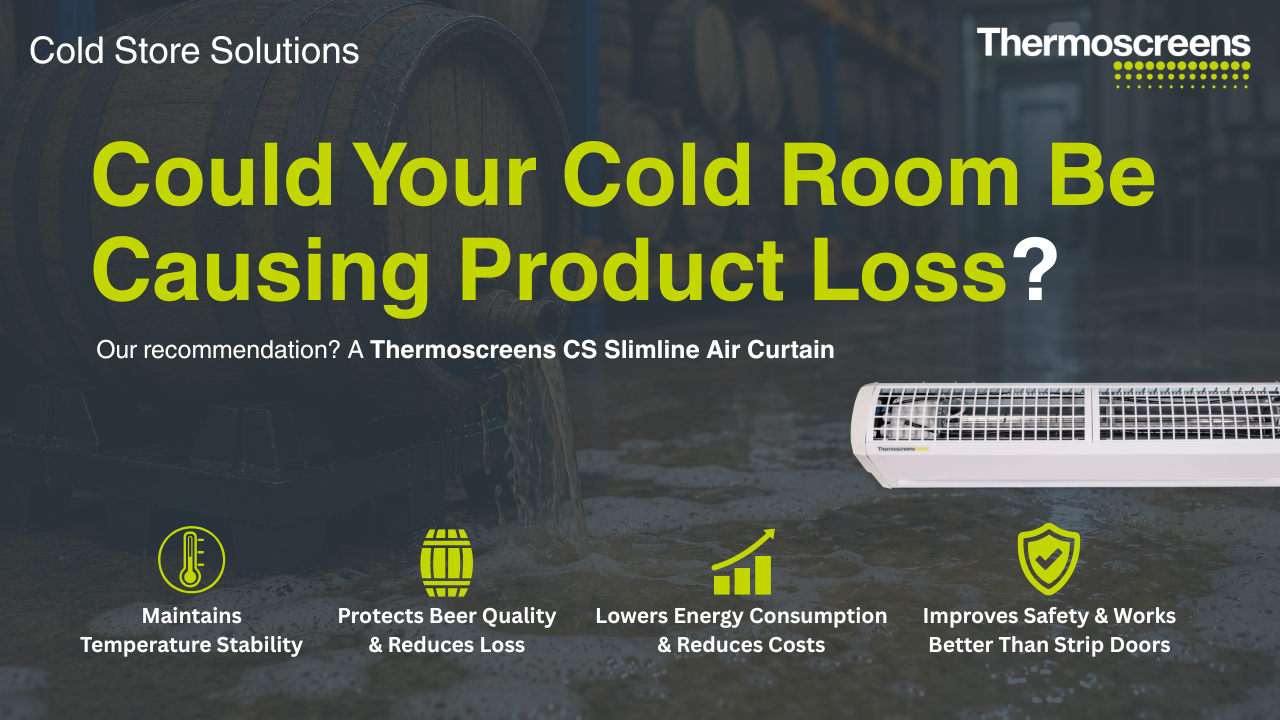
Door traffic is the single biggest lever a brewery has over its own cold store stability, for one simple reason: it’s the only major heat source in the system that’s directly caused by human and operational activity rather than the building envelope or the plant.
Breweries tend to have particularly demanding door traffic profiles compared with general food cold storage:
- High-frequency, short-cycle movements — kegging lines, case pallets, and crate returns moving in and out throughout a shift, rather than a handful of large deliveries.
- Forklift and pallet truck access, which usually requires a wider, taller opening than a walk-in door, increasing the air exchange area.
- Seasonal peaks around events, festivals, and holiday periods, where door traffic spikes sharply and the cold store is under the most pressure precisely when consistency matters most.
Every one of those openings is an opportunity for warm, moisture-laden air to displace the store’s cold air layer. Without a barrier at the doorway, the refrigeration plant is left to chase that intrusion after the fact — which is exactly the reactive, energy-expensive pattern that shows up as both the electricity cost and the flavour-stability cost described above.
How Does Door Traffic Impact Brewery Cold Storage Temperature Stability?
An air curtain creates a controlled, high-velocity stream of air across the full width and height of a doorway, forming an invisible barrier between the conditioned cold store air and the warmer ambient air outside. It doesn’t replace the door or the refrigeration plant — it protects both, by stopping the air exchange that would otherwise happen every time the door is opened or left ajar.
For a brewery cold store specifically, the practical requirements are different from a retail chiller cabinet or a warehouse loading bay:
- Sufficient air velocity and throw to hold a barrier across wide, tall openings used by forklifts and pallet trucks, not just pedestrian doors.
- Low-temperature-rated components engineered to run continuously in a cold, humid environment without icing up or degrading.
- Low noise and low draught at working height, since staff are moving through the doorway constantly during a shift.
- Controls that integrate with door-open/door-closed sensors and BMS systems, so the curtain and the refrigeration plant work together rather than each reacting independently.
This is the distinction between a general-purpose air curtain and one engineered specifically for cold storage duty — and it’s the gap that shows up in a facility’s energy and consistency data within the first few months of use.
What Is the ROI of Air Curtains in Brewery Cold Stores?
Air curtain payback for cold storage doorways is one of the more favourable business cases in facilities engineering, because the mechanism is direct: less warm air in means less refrigeration work done, and less refrigeration work done means a lower electricity bill on the same production output.
When modelling the ROI of air curtains in cold storage, breweries should weigh up:
- Reduced refrigeration run time and compressor cycling, driven by less heat load entering through the doorway — the underlying reason air barriers have been shown to cut refrigeration energy use by up to 79.7% at protected openings.
- Fewer defrost-related demand spikes, since a stable store needs less aggressive defrost management.
- Extended equipment life, as compressors and evaporators cycle less aggressively and less often.
- Reduced product-related cost, from the flavour-stability and shelf-life angle covered above — harder to quantify precisely, but directly tied to the same root cause.
- Lower maintenance overhead on door seals and hardware, which see less thermal and physical stress once the curtain is taking the brunt of the air exchange.
The specific payback period depends on doorway size, traffic frequency, ambient conditions, and the store’s current baseline energy use — which is exactly the kind of site-specific modelling a Thermoscreens cold storage specification review is built to produce.
What Should Breweries Look for When Choosing Cold Store Door Protection?
Not every air curtain is built for a cold, high-traffic, forklift-accessed doorway. When specifying cold store door protection for breweries, look for:
- A model range specifically rated for low-temperature and cold storage duty, not a generic commercial air curtain adapted for the job.
- Documented performance data at the actual doorway dimensions in question — width, height, and traffic type, not a generic “suitable for cold storage” claim.
- Controls compatible with existing BMS and refrigeration monitoring, so temperature stability data can actually be tracked over time rather than assumed.
- A manufacturer with brewing and food & drink cold chain reference sites, since the traffic patterns, hygiene requirements, and duty cycles in this sector differ meaningfully from retail or general warehousing.
- Installation and commissioning support that accounts for the doorway’s role in the wider refrigeration system, not just the curtain unit in isolation.
Thermoscreens’ HE Air Curtain range was engineered around exactly this brief: low-temperature-rated performance for cold storage and cold chain doorways, validated against real ice build-up and temperature-stability data from working sites including supermarket distribution cold stores. The same engineering principles that protect a retail cold store apply directly to a brewery’s kegging and packaging cold stores, where door traffic is frequent and the cost of instability compounds quietly in the background.
A Stable Cold Store Is a Cost Control, Not Just a Compliance Line
Temperature fluctuation in a brewery cold store is easy to overlook precisely because it rarely breaches a hard alarm limit. But the underlying pattern — warm air entering through the doorway, the refrigeration plant working harder to recover, and the product’s flavour clock quietly ticking faster every time it happens — is consistent, measurable, and, importantly, controllable at the door.
Breweries that treat the doorway as part of the refrigeration system, rather than a gap in it, tend to see the improvement show up in three places at once: a flatter, more defensible temperature log; a lower proportion of revenue spent on refrigeration; and beer that tastes the way it was brewed to taste for longer.
FAQs: Brewery Cold Store Temperature Fluctuations
What is the ideal brewery cold store temperature range? Most brewery cold stores for packaged beer are held between 2°C and 4°C, though the exact target depends on the product, packaging format, and the brewery’s own shelf-life specification. What matters more than the exact number is how tightly the store holds that number — a store that drifts by 3–4°C several times a day carries more flavour-stability risk than one held slightly warmer but stable.
How do temperature fluctuations differ from a refrigeration fault? A refrigeration fault is a plant failing to reach or hold its set point at all. A temperature fluctuation is the plant working correctly but being repeatedly disturbed — usually by door openings, poor seals, or defrost cycles — so the room oscillates around the set point rather than sitting flat on it. Fluctuation is often invisible to a simple high/low alarm because it rarely breaches the alarm threshold.
How much energy do cold store doors actually waste? It varies by doorway size, traffic frequency, and seal condition, but door-related heat infiltration is a significant, controllable share of total refrigeration demand — audits of failing door seals alone have found infiltration loads equivalent to 14% of total refrigeration demand in the affected zones.<sup>[6]</sup> Unprotected, high-traffic doorways typically represent an even larger share.
Can an air curtain really replace a strip curtain or rapid-action door? An air curtain isn’t usually a replacement for a physical door — it’s a complement to one, protecting the opening during the periods when the door itself is open or in frequent use. Many brewery cold stores use both: a door or strip curtain for when the space is unattended, and an air curtain to maintain the barrier during active traffic.
What’s the fastest way to check if our cold store has a fluctuation problem? Pull the temperature logging data (most modern refrigeration controllers record this already) and look at variance across a working day rather than just the daily average. A store that looks fine on average but shows repeated multi-degree swings tied to shift patterns or delivery windows almost always has a door-related root cause worth investigating.
Ready to see what a stable cold store would look like on your site? Thermoscreens works with breweries and cold chain operators to specify air curtain solutions matched to real doorway traffic and refrigeration data — not generic sizing charts. [Get in touch with the Thermoscreens team] to discuss a site-specific cold storage door protection review.

Testimonials
“We’ve been very pleased with your products and would like to continue using them as a design feature in all our shops.”
- Project Manager, large ice-cream manufacturer.
“Wrapped up and gone before the lunch service, great turnaround from order to delivery.”
- Director, Restaurant in Aldwych
“Thank you for having an excellent working relationship with me, you are a credit to Thermoscreens.”
- Technical Engineer, HVAC
“The new air curtains in the freezer room have completely eliminated any ice and frost build up around the room, including the evaporators. As the main reason for cold room failure, this will undoubtedly help to reduce costly downtime, stock loss and maintenance calls.”
- Refrigeration Manager at leading supermarket
“The units we installed at Birmingham this week. We really enjoyed installing your units and would like to use them moving forward with the other stores.”
- Installer, Restaurant in Birmingham
“I would like to take this opportunity to thank you all for your performance, we have all been very impressed with your response to queries and turnaround of air curtains.”
- Installer, HVAC
“Thank you for all your support. We couldn’t have won this project without your assistance.”
- Senior engineer