Cold Storage Without the Bottleneck: Keeping Distribution Centres Moving.
In a cold storage warehouse, the doorway is where speed and temperature control collide. Every forklift pass lets warm, humid air in, and every fix that slows the forklift slows the whole distribution centre.
The stakes are growing. The UK cold chain is a £14 billion industry supporting £53 billion of food, drink and pharmaceutical sales, and it handles almost half of all UK-produced food and beverages (Warehouse & Logistics News, June 2026). Savills counts 678 UK warehouse units with more than 50,000 sq ft of cold storage, totalling 134 million sq ft (Cold Chain Federation).
More throughput means more door openings. And in refrigerated spaces where doors stay open for long periods, infiltration can account for more than half of the total refrigeration load (Gonçalves et al., 2012).
This guide explains why cold store doors become bottlenecks in cold chain logistics, what each doorway solution really costs you in time and energy, and how a cold store air curtain keeps goods cold and traffic moving at the same time.
What causes bottlenecks at cold storage warehouse doors?
Short answer: Bottlenecks happen when the barrier protecting the cold store also blocks the traffic using it. Slow doors, torn strip curtains and icy floors all force forklifts to stop, wait or slow down.
In a high-throughput cold storage warehouse, the pinch points usually look like this:
- Door cycle time. Every second a door takes to open and close is a second a forklift waits. Across hundreds of movements per shift, that adds up to hours.
- Doors left open. When operators prop doors open to keep pace, warm air pours in unchecked.
- Strip curtain drag. PVC strips obstruct drivers’ view, get damaged by masts and pallets, and trap dirt in a food-safe environment.
- Ice and hoarfrost. Moist air freezing at the threshold creates slip hazards, damages doors and forces slower, more careful driving.
- Temperature recovery. After a heavy loading period, compressors work flat out to pull the room back down, risking product temperature excursions.
The common thread in every cold storage warehouse is air infiltration. Fix the airflow at the doorway and most of the bottleneck disappears with it. For a deeper look at the physics, see How Much Energy Does an Open Cold Store Door Actually Waste?
How much cold store door energy loss is really happening?
Short answer: More than most cold storage warehouse operators realise. Infiltration through doorways is one of the largest single contributors to refrigeration load, and it scales directly with how long the door is open.
The research is consistent:
- Infiltration through a rapid-roll door into a -18°C cold store was proportional to the fraction of time the door stood open (Chen et al., IIR Congress 1999).
- Where doors stay open for long periods, infiltration can exceed half of the total refrigeration load (Gonçalves et al., 2012).
- An ASHRAE field study of eight doorway protection devices, tested under live forklift traffic, found effectiveness ranging from 98% down to -230%, with the worst results caused by negative pressure in the store (Downing & Meffert, ASHRAE Transactions).
- Electricity makes up around 70% of a cold storage warehouse’s total energy bill (Research and Markets).
That ASHRAE range is the key takeaway for operations managers. The wrong doorway device, or the right one badly installed, can leave you worse off than doing nothing.
The hidden costs go beyond the energy bill: extra evaporator defrost cycles, shorter compressor life, stock at risk during temperature excursions and slip incidents on icy floors. Our guide to the hidden cost of ice build-up in cold chain warehouses covers these in detail.

Air curtain vs strip curtain for forklift traffic: which keeps a DC moving?
Short answer: Strip curtains seal well when nothing is passing through them, but lose effectiveness under forklift traffic. Rapid-roll doors cut open time but add cycle time and damage risk. An air curtain gives an unobstructed opening while holding the temperature line.
A strip curtain reduced infiltration by 92% in one -18°C cold store study, but forklift traffic reduced its effectiveness (Chen et al., IIR). That is the problem in a busy cold storage warehouse: the device performs best when the door is least used.
| Doorway solution | Traffic flow | Infiltration control | Ice and safety |
|---|---|---|---|
| PVC strip curtain | Obstructs view, slows drivers | Good when static, drops under traffic | Strips stiffen, tear and trap frost |
| Rapid-roll door alone | Stop-start at every pass | Good when closed, none when open | Ice can foul tracks and sensors |
| Cold store air curtain | Fully open, clear sightlines | Continuous barrier while open | Reduces frost at the threshold |
| Air curtain + rapid-roll door | Door opens only when needed | Barrier covers every open cycle | Best overall frost control |
| Best overall frost control | Moderate |
For many high-traffic sites the strongest answer is a combination: a fast door for idle periods, with an air curtain covering every opening. We compare the running costs in more depth in Why Strip Curtains Could Be Costing Your Cold Store Thousands.
How does a cold store air curtain work?
Short answer: A cold store air curtain projects a controlled stream of air across the doorway. That stream separates the cold, dense air inside from the warm, humid air outside, so the door can stay open without the temperature collapsing.
Without protection, cold air spills out along the floor while warm air rushes in across the top of the opening. An air curtain interrupts that exchange. This is known as climate separation.
The Thermoscreens CS Cold Store Air Curtain is engineered specifically for this job:
- Maintains climate separation in stores down to -25°C
- Advanced EC motor technology to reduce energy and carbon use
- Built-in frost protection so goods can move safely
- Adjustable hanging bracket for directional airflow
- No physical barrier, so stock can be moved quickly
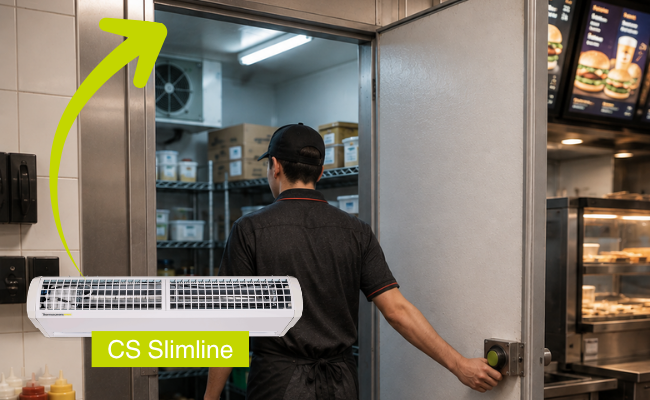
For stores where headspace is tight, the Slimline CS Air Curtain delivers the same climate separation principle in a compact body, with proven performance down to -25°C. For washdown areas and food production chillers, the stainless-steel, IP66-rated HE Harsh Environments Air Curtain is the better fit.
New to the technology? How air curtains work explains the principles in plain English.
What is the cold store air curtain ROI?
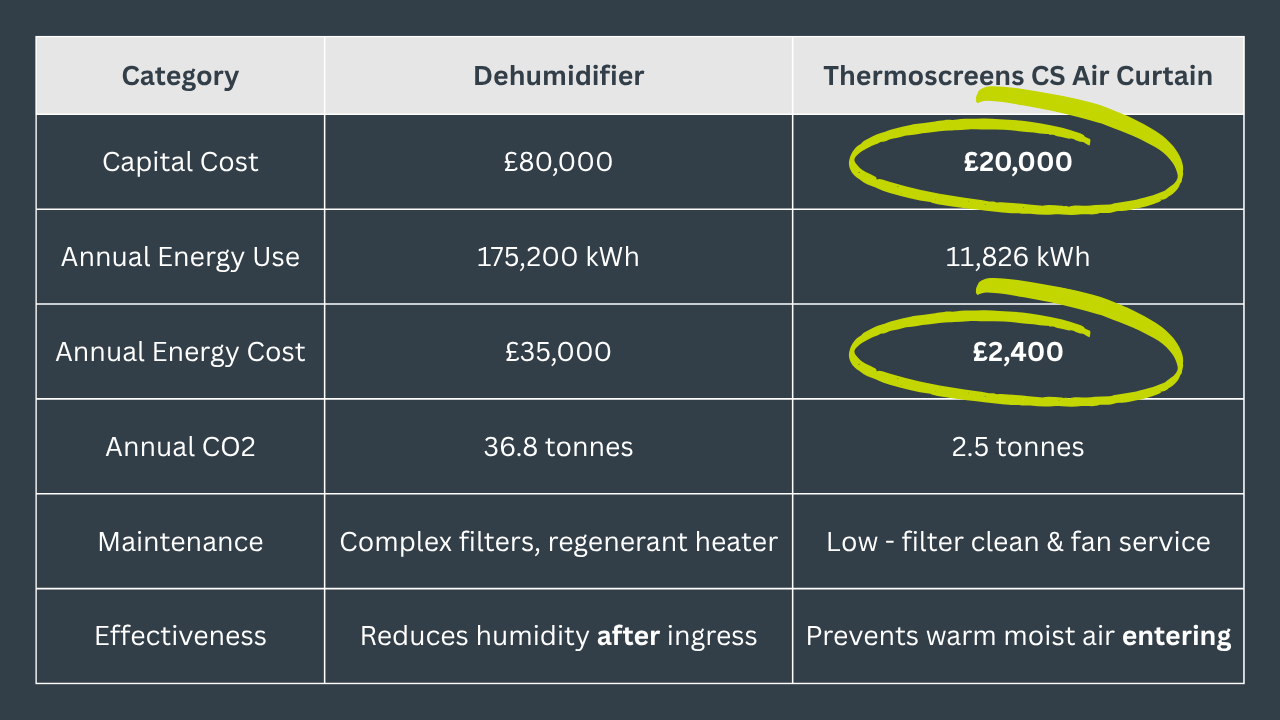
Short answer: In Thermoscreens field trials, air curtains have cut refrigeration energy by double-digit percentages, with a projected payback of around two years. Savings come from lower compressor load, fewer defrost cycles and less ice-related downtime.
Dovecote Park chiller trial. A 2m stainless-steel HE Air Curtain was installed at a busy chiller entrance, with a power meter on the compressor incomer (full case study):
- Air curtain on: 2,846 kWh over one week
- Air curtain off: 3,346 kWh over a comparable week, roughly 15% higher
- Air curtain back on: 2,955 kWh
- Estimated savings of £4,371 to £5,590 a year at 21.5p/kWh, with a projected ROI of about two years
That result came despite a sub-optimal position next to an evaporator fan, at the upper limit of mounting height.
Supermarket cold store trial. A CS Air Curtain was fitted with full monitoring of temperatures, door openings and compressor energy (full case study):
- Temperature variation across the room fell from around 5°C to within 1°C
- Temperature rise during door openings held below 3°C
- Compressor off-time increased by approximately 1,600%
- No significant ice build-up reported for around two years after installation
Independent research points the same way. A comparative study found high-efficiency air curtains cut heat gains through a cold room door by 80% versus a physical separation system, with a shorter amortisation period (Universidad Politécnica de Madrid).
Your own ROI depends on door size, opening frequency, store temperature and tariff. A free site survey is the fastest way to model it.
How do you specify an air curtain for high-traffic doors in a cold storage warehouse?
Short answer: Match the unit to the door, the temperature difference and the traffic pattern, then install it correctly. Specification and installation matter as much as the product itself.
Use this checklist before you invest:
- Audit door traffic. Log openings per hour, peak loading windows and dwell times. High-frequency doors deliver the fastest payback.
- Measure the opening. Width and mounting height determine the model and airstream coverage.
- Know your temperatures. Chilled and frozen stores need different performance. The CS range works down to -25°C.
- Check store pressure. Negative pressure can undermine any doorway device, as the ASHRAE field data shows. Balance the building first.
- Plan around evaporators. Avoid positioning next to evaporator fans that disturb the airstream where possible.
- Consider the environment. Washdown areas need stainless-steel, IP66-rated units such as the HE range.
- Measure before and after. Fit sub-metering on the compressor so you can prove the saving, as in the Dovecote and supermarket trials.
- Combine where it makes sense. On dock doors and external openings, pair a rapid-roll door with an air curtain.
Our air curtain specification guidance and Product Selector help narrow down the right unit, and tender texts are available for consultants.
Frequently asked questions
Can a cold storage warehouse keep doors open without losing temperature?
Yes, with climate separation. A cold store air curtain creates a continuous air barrier across the open doorway, limiting warm air ingress while forklifts pass freely.
Is an air curtain better than a strip curtain for forklift traffic?
For busy doors, usually yes. Strip curtains lose effectiveness under forklift traffic, obstruct sightlines and need regular replacement. Air curtains leave the opening clear.
How do you reduce ice build-up at cold store doors?
Stop moist, warm air reaching the cold threshold. An air curtain with built-in frost protection reduces hoarfrost at the doorway; one supermarket reported no significant ice build-up for around two years after installing a CS unit.
What is the typical cold store air curtain ROI?
In the Dovecote Park trial, projected payback was around two years, with estimated savings of £4,371 to £5,590 a year. Results vary with door traffic, temperatures and energy tariff.
How much cold store door energy loss comes from infiltration?
Where doors are open for long periods, infiltration can exceed half the total refrigeration load. Loss rises in direct proportion to how long the door is open.
What temperature can a cold store air curtain work at?
The Thermoscreens CS and Slimline CS air curtains maintain climate separation in stores down to -25°C.
Do air curtains work in cold chain logistics sites with dock doors?
Yes. On dock doors and external openings, an air curtain works best alongside a rapid-roll door, covering every open cycle.
Will an air curtain slow down my distribution centre?
No. There is no physical barrier and no door cycle, so drivers keep full speed and clear visibility.
Keep the cold in and the traffic flowing
Your busiest door is also your biggest leak. In a cold storage warehouse, you shouldn’t have to choose between throughput and temperature control.
Our cold chain range is proven in live supermarket, food production and cold store environments, with measured results to back it up.
Ready to see what your doorway is costing you?
- Book a free site survey and we’ll assess your door traffic, temperatures and payback.
- Request a quote for the CS or Slimline CS Cold Store Air Curtain.
- Explore our cold storage solutions and case studies.
Or call our team on +44 (0) 24 7638 4646.
Testimonials
“We’ve been very pleased with your products and would like to continue using them as a design feature in all our shops.”
- Project Manager, large ice-cream manufacturer.
“Wrapped up and gone before the lunch service, great turnaround from order to delivery.”
- Director, Restaurant in Aldwych
“Thank you for having an excellent working relationship with me, you are a credit to Thermoscreens.”
- Technical Engineer, HVAC
“The new air curtains in the freezer room have completely eliminated any ice and frost build up around the room, including the evaporators. As the main reason for cold room failure, this will undoubtedly help to reduce costly downtime, stock loss and maintenance calls.”
- Refrigeration Manager at leading supermarket
“The units we installed at Birmingham this week. We really enjoyed installing your units and would like to use them moving forward with the other stores.”
- Installer, Restaurant in Birmingham
“I would like to take this opportunity to thank you all for your performance, we have all been very impressed with your response to queries and turnaround of air curtains.”
- Installer, HVAC
“Thank you for all your support. We couldn’t have won this project without your assistance.”
- Senior engineer