Stop Paying to Cool the Corridor: The Retail Cold Room Fix.
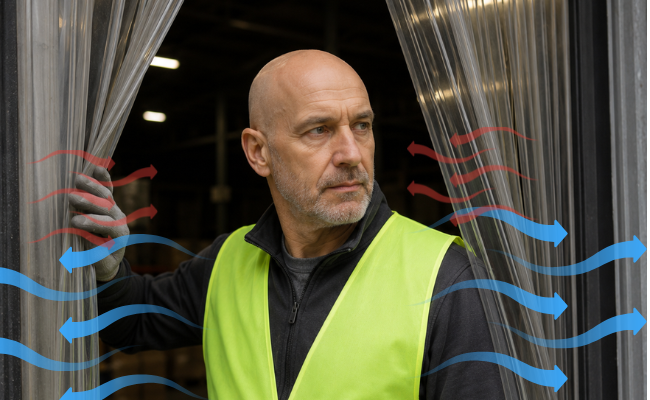
In a busy supermarket back-of-house, a walk-in cold room door can open more than 300 times a shift. Every one of those openings is a small but expensive event — a column of cold air spilling out at floor level, a column of warm, moisture-laden air rushing in at head height, and a refrigeration plant working harder to put things back the way they were. For retailers under pressure to cut energy bills, hit sustainability targets and keep product quality high, the humble cold room doorway is one of the most overlooked margin opportunities on site.
This guide explains how a properly specified cold room air curtain lets retailers keep cold air in without restricting access — and why it has become the default solution for walk-in cold rooms across UK supermarkets, convenience stores, butchers, fishmongers, food halls and quick-service kitchens. As one of the longest-established air curtain manufacturers in the UK, Thermoscreens has spent more than five decades engineering doorway climate-separation products for exactly this challenge.
Why retail cold rooms are an energy hotspot
Refrigeration is the single biggest electrical load in most food retail environments. Research published by the International Journal of Refrigeration and summarised by London South Bank University’s refrigeration research group found that 60–70% of electricity consumed in a cold storage facility goes to refrigeration alone, and that energy savings of 30–40% are achievable through better operation, repair and retrofit of cold rooms.
At a sector level, retail food outlets account for roughly 3% of total UK electrical consumption and around 1% of national greenhouse gas emissions, with cold rooms and refrigerated display a dominant share of that footprint (ScienceDirect, Tassou et al.). The Cold Chain Federation has since published updated best-practice benchmarks showing that modern, well-managed cold stores can run at less than a third of the energy intensity assumed by older UK guidelines — but only when air infiltration, door discipline and refrigeration plant are all under control.
The point is simple: the cold room is where the kWh hides. And the doorway is where the kWh escapes.
How does cold air actually escape from a retail cold room?
When a cold room door opens, the temperature difference between inside (typically +1°C to +4°C for chillers, −18°C to −22°C for freezers) and the warmer ambient space creates a pressure imbalance. Physics does the rest:
- Cold, dense air falls out at floor level, flowing into the back-of-house corridor.
- Warmer, humid air flows in at the top of the doorway, rising as it enters the cold room.
- This creates a continuous, self-reinforcing exchange known as gravity-driven infiltration or “stack effect.”
Even with the door closed, door seal degradation, frequent traffic, trolleys propping doors open and damaged strip curtains can keep that exchange running for much of the trading day. The result is three compounding problems:
- Energy waste — the refrigeration plant cycles harder and longer to recover setpoint.
- Condensation, ice and frost — warm humid air condenses on cold surfaces, leading to slippery floors, frosted evaporators and ice build-up around door frames.
- Product quality issues — temperature fluctuation accelerates spoilage of chilled meat, fish, dairy and produce, with knock-on impacts on shelf life and waste.
This is the core problem a cold room air curtain is designed to solve.
What is a cold room air curtain, and how does it work?
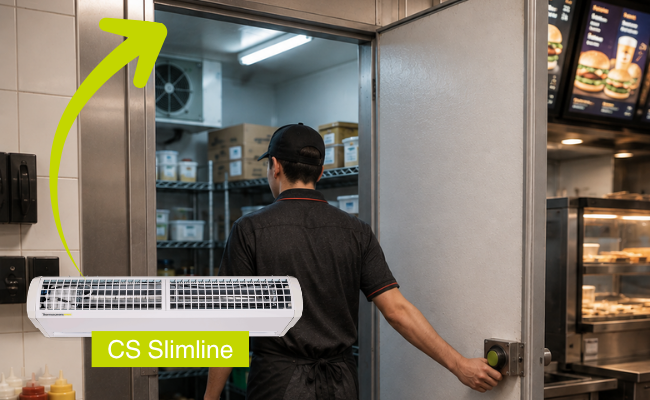
A cold room air curtain (also called an air door, air screen or air barrier) is a unit mounted above a doorway that projects a high-velocity, controlled jet of air downward across the opening. That jet creates an invisible aerodynamic barrier between the two environments — keeping cold, dry air inside the cold room and warm, humid air outside, while allowing people, trolleys and pallet trucks to pass through without obstruction.
For retail cold room applications, the air curtain is usually ambient (non-heated) — the goal is climate separation, not warming the doorway. Premium units use:
- Twin-skin construction with thermal break, to prevent condensation on the unit’s own casing.
- High static pressure fans to maintain jet integrity against pressure differentials and door traffic.
- Adjustable discharge nozzles, so installers can angle the jet outward (typically 5–20° toward the warm side) to optimise the seal.
- Door switch integration, so the unit runs only when the door is open — a small but important efficiency detail.
Independent CFD (computational fluid dynamics) studies and field tests by manufacturers including Frico have shown that a properly installed air curtain can reduce energy loss through an open doorway by up to 80%. A joint study by the Air Movement and Control Association (AMCA) found that air curtains reduce air infiltration by approximately 65% compared with an open single door, while traditional vestibules achieve only around 23%.
In short: in retail cold room conditions, an air curtain is the most effective non-physical doorway barrier available.
Cold room air curtain vs PVC strip curtain vs vestibule: which is best?
Retailers usually weigh three options for cold room entrances. Each has a role, but they are not equivalent.
PVC strip curtains
Strip curtains are inexpensive and effective in the right context. The Energy Saving Trust has noted that they can cut cold-room cooling costs by 40% or more when installed correctly. However, in busy retail environments, strip curtains have well-known drawbacks:
- They become damaged, brittle and discoloured within months in high-traffic walk-ins.
- Staff often tie them back for trolley access, defeating the seal.
- They obstruct sightlines, creating manual handling and slip risks.
- They are difficult to clean to food-safety standards.
Vestibules (double-door lobbies)
Vestibules work well in principle but are space-hungry, expensive to build, and rarely practical in retrofit retail back-of-house layouts. AMCA-funded research has found that air curtains can be up to 10% more energy efficient than vestibules for environmental separation, at a fraction of the construction cost.
Cold room air curtains
A purpose-designed walk-in cold room air curtain delivers the seal of a vestibule with the access of an open doorway and none of the hygiene or handling problems of strip curtains. It is the only option that:
- Allows unrestricted trolley and pallet truck access.
- Maintains a clear line of sight for staff safety.
- Is easy to clean and inspect to BRC / SALSA food safety standards.
- Integrates with door switches and BMS for measurable control.
For most modern retail cold rooms, the optimum specification is often an air curtain combined with a high-speed door or insulated swing door — physical closure when not in use, aerodynamic seal when open.
What features should retailers look for in a cold room air curtain?
Not every air curtain is suitable for cold room duty. When specifying for a retail walk-in cold room, the key criteria are:
- Discharge velocity and jet integrity at the floor. The jet must reach the floor with enough velocity to resist the stack-effect pressure across the door. Underpowered units fail at exactly the point they are needed most.
- Ambient (unheated) operation for chillers and freezers — heating the doorway is counter-productive.
- Twin-skin, thermally broken casing to prevent condensation forming on the unit and dripping onto floors or product.
- Stainless steel or hygienic coated finishes for food-safety compliance and easy washdown.
- IP-rated electrics appropriate for humid environments.
- Door switch / contact integration so the unit only runs on door opening.
- Low noise profile — back-of-house staff work near these units for full shifts.
- Variable speed control and BMS integration for energy management.
- Width matching the doorway — a unit narrower than the door leaves unsealed gaps at the edges.
A useful resource for buyers is the Thermoscreens cold storage range and the manufacturer’s specification guide for industrial and cold room applications.
How do you size and install a cold room air curtain correctly?
Correct sizing is the single biggest determinant of real-world performance. The most common installation mistakes are undersizing, mounting too high, and ignoring pressure differentials. Best practice:
- Match the unit length to the full doorway width. An air curtain shorter than the door cannot seal the edges, where infiltration is highest.
- Mount as close to the top of the doorway as practical. The higher the mount, the more jet velocity is lost before the air reaches the floor.
- Aim the discharge slightly toward the warm side (typically 5–20°). This compensates for the pressure pushing back on the jet.
- Wire to a door switch so the unit cycles with door operation, not continuously.
- Commission with airflow measurement at the floor, not just at the discharge, that is where the seal either works or fails.
- Specify for the worst-case scenario: maximum temperature differential, peak traffic, and worst-case adjacent HVAC pressure conditions.
For walk-in freezers (−18°C and below), specifying a unit designed specifically for cold store applications, with appropriate motor protection, casing material and condensation management — is essential. Standard commercial entrance air curtains are not interchangeable with cold room units.
What is the ROI of installing a cold room air curtain?
The ROI question is where retail operators usually focus, and rightly so. The honest answer is that payback depends on four variables:
- Temperature differential between the cold room and the surrounding space.
- Door traffic frequency (how many times per shift the door opens).
- Energy unit cost (in £/kWh — significantly more material since 2022).
- Refrigeration system efficiency (a less efficient plant amplifies the saving).
In typical UK retail conditions, most cold room air curtain installations achieve payback within 1 to 3 years, with continued energy and product-quality savings thereafter. Thermoscreens has published detailed real-site ROI data in its case study, Do Air Curtains Actually Pay for Themselves? Real ROI Data Explained, which walks through measured savings from a live cold storage installation.
Beyond the kWh saving, retailers should also account for:
- Reduced ice and frost build-up on evaporators (lower defrost cycle energy, longer plant life).
- Reduced de-icing labour around door frames.
- Lower slip risk from doorway condensation.
- Better temperature stability and therefore reduced product waste and longer shelf life.
- Compliance with food safety and refrigeration regulations under HSE, BRC and SALSA frameworks.
Taken together, the total cost-of-ownership case for a properly specified cold room door air curtain is normally compelling within the first heating season after install.
How does Thermoscreens approach retail cold room applications?
Thermoscreens is a British air curtain manufacturer with more than 50 years of experience designing doorway climate-separation products for retail, commercial and industrial use. The company is a member of the British Frozen Food Federation and the Cold Chain Federation, and works closely with major UK supermarket groups, food manufacturers and refrigeration contractors on cold room specification.
Specifically for retail cold rooms, the Thermoscreens approach focuses on:
- Application-matched specification — units engineered for the actual temperature differential, doorway dimensions, traffic profile and food-safety environment, rather than generic commercial units.
- Hygienic, easy-clean construction — appropriate finishes and IP ratings for back-of-house food environments.
- BMS-ready controls so retailers can measure, monitor and prove the saving.
- In-house technical support for installers and refrigeration contractors during commissioning.
- A UK manufacturing base with quick lead times and on-the-ground service.
If you would like to see how this works in practice, the Thermoscreens cold storage case studies and ROI data document measured outcomes from real installations.
Practical implementation: getting the most out of your cold room air curtain
Specifying the right unit is only half the job. Real-world performance also depends on what happens after install:
- Train staff to keep doors closed wherever practical, even with an air curtain fitted. The air curtain manages the unavoidable; door discipline manages the avoidable.
- Maintain physical door seals — a degraded gasket undoes much of the seal benefit.
- Schedule filter and intake cleaning as part of routine refrigeration maintenance.
- Review BMS data quarterly — door open-time, compressor run-time and defrost frequency are the leading indicators that the seal is working.
- Re-commission after any layout change — moving a doorway, adding HVAC or changing adjacent extraction can all shift the pressure balance across the door.
Frequently asked questions
Do air curtains actually keep cold air inside a walk-in cold room?
Yes. When correctly sized, mounted and commissioned, an air curtain creates a high-velocity aerodynamic barrier that significantly reduces the exchange of cold and warm air through an open doorway. Independent studies have measured air infiltration reductions of around 65% versus an open single door, and energy loss reductions of up to 80% in optimised installations.
How much can a cold room air curtain save on energy bills?
Most retail cold room installations achieve payback within 1 to 3 years, after which the savings continue. The exact figure depends on temperature differential, door open frequency, energy tariff and refrigeration plant efficiency. A site-specific ROI assessment is the only way to give an accurate number, but published real-site data from Thermoscreens and from independent manufacturers consistently shows double-digit percentage energy savings on doorway-related refrigeration load.
Air curtain or strip curtain — which is better for a cold room?
For low-traffic, low-spec applications, strip curtains can be effective and inexpensive. For busy retail cold rooms, an air curtain is normally the better long-term choice: it does not obstruct trolley or pallet truck access, does not degrade, does not get tied back by staff, is easier to clean to food-safety standards, and integrates with door switches and BMS. In some sites, the two are combined.
Do I need a heated air curtain for a cold room?
No. For chillers and freezers, the goal is climate separation, not warming the doorway. Cold room air curtains are typically ambient (unheated) units. Heated air curtains are used at building entrances where you want to maintain a warm internal environment — a different application.
What size air curtain do I need for my walk-in cold room?
The air curtain must match the full width of the doorway and have enough discharge velocity to reach the floor with sufficient force to resist the pressure differential. The correct specification depends on doorway height and width, the temperature differential, and the surrounding pressure conditions. Manufacturers including Thermoscreens provide free specification support to confirm the right model for a given doorway.
Will an air curtain restrict access for staff and trolleys?
No — that is one of its core advantages. The air jet is aerodynamic, not physical. Staff, trolleys and pallet trucks pass through without obstruction or contact, which is why air curtains are preferred over strip curtains in busy retail back-of-house environments.
Are cold room air curtains compliant with food safety regulations?
Yes, when correctly specified. Units intended for food environments should have hygienic, easy-clean construction, appropriate IP ratings and finishes suitable for washdown. They support compliance with BRC, SALSA and HSE expectations around temperature control and contamination prevention.
How long does a cold room air curtain installation take?
A typical retrofit install on an existing doorway takes a few hours per unit, plus electrical connection and commissioning. New-build installations are usually integrated into the refrigeration and BMS commissioning programme.
Small doorway, large margin.
The retail cold room is one of the few areas of a modern store where a relatively small capital investment still moves the energy needle in a measurable way. A correctly specified cold room air curtain lets retailers keep cold air in, keep warm humid air out, keep staff and trolleys moving freely, and keep refrigeration plant working within design limits — all at the same time.
In a retail environment where every kWh, every percentage point of waste and every minute of plant runtime matters, the doorway is no longer a detail to overlook.
Talk to Thermoscreens about your cold room
If you are specifying a new retail cold room, retrofitting an existing one, or simply trying to understand where energy is being lost across your estate, Thermoscreens’ technical team can help. We will assess your doorways, model the energy and ROI impact, and recommend a specification matched to your actual operating conditions.
Request a free cold room specification consultation →



Testimonials
“We’ve been very pleased with your products and would like to continue using them as a design feature in all our shops.”
- Project Manager, large ice-cream manufacturer.
“Wrapped up and gone before the lunch service, great turnaround from order to delivery.”
- Director, Restaurant in Aldwych
“Thank you for having an excellent working relationship with me, you are a credit to Thermoscreens.”
- Technical Engineer, HVAC
“The new air curtains in the freezer room have completely eliminated any ice and frost build up around the room, including the evaporators. As the main reason for cold room failure, this will undoubtedly help to reduce costly downtime, stock loss and maintenance calls.”
- Refrigeration Manager at leading supermarket
“The units we installed at Birmingham this week. We really enjoyed installing your units and would like to use them moving forward with the other stores.”
- Installer, Restaurant in Birmingham
“I would like to take this opportunity to thank you all for your performance, we have all been very impressed with your response to queries and turnaround of air curtains.”
- Installer, HVAC
“Thank you for all your support. We couldn’t have won this project without your assistance.”
- Senior engineer