How to Reduce Ice Build-Up in Cold Storage Warehouses and Distribution Centres.
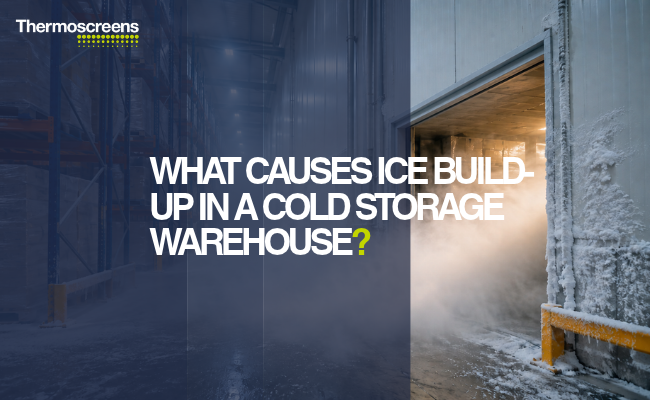
To reduce ice build-up in a cold storage warehouse, stop warm, moist air getting in at the doorway. Most ice in cold stores starts at the door. When you separate the air at your busiest cold store doors, the ice has nothing to form from.
That matters more than ever. More than half of the food eaten in the UK is chilled or frozen. It moves through around 450 temperature-controlled warehouses, according to the Cold Chain Federation. The Federation has asked the government to recognise the cold chain as critical national infrastructure.
In a distribution centre, the cold store door rarely gets a rest. Forklifts and pallet trucks pass through hundreds of times a day. Every opening brings in heat and humidity, and that moisture ends up as frost on evaporators and ice on floors, racking and door frames.
This guide covers:
- what causes ice build-up at cold store doors
- why it is a safety, energy and uptime problem
- the practical steps that reduce it
- how the common doorway solutions compare on high-traffic cold store doors
- how the new Thermoscreens CS Tower air curtain keeps the cold in without slowing traffic down
Thermoscreens has designed and manufactured air curtains in Nuneaton for decades. Its cold chain range covers chillers, freezers and harsh washdown environments down to −25°C.
What causes ice build-up in a cold storage warehouse?
Ice forms when warm, humid air meets sub-zero surfaces. In most cold storage warehouses, that air comes in through the cold store doors.
The process works like this:
- The door opens. Cold air is denser than warm air, so it spills out at floor level. Warm air rushes in at the top of the opening. The Global Cold Chain Alliance describes this as a two-way exchange through the doorway.
- Moisture comes with it. The incoming air carries water vapour. Research presented to the Institute of Refrigeration found that air can enter an open cold store door at 0.5 to 2 m/s, depending on door size and store height.
- The moisture condenses and freezes. It settles as frost on evaporator coils and as ice on floors, door frames, racking and ceilings near the opening. In ante-chambers above 70% relative humidity, it can also form fog.
The busier the door, the worse the problem. The same Institute of Refrigeration paper notes that heavily used doors can be open for more than 1,000 hours a year.
Other contributors include worn door seals, damaged strip curtains, poor defrost settings and doors left open between loads. On a high-traffic cold store door, though, the open doorway is the main source.
Why is ice on cold store floors such a problem?
Ice at the doorway costs you in three ways: safety, energy and uptime. As Chris Collins, Group Sales and Marketing Director at Thermoscreens, puts it: “Every time a cold store door opens, the site pays for it.”
Safety: ice and forklifts don’t mix
Ice on cold store floors is a serious hazard wherever forklifts and pallet trucks operate. A loaded truck braking or turning on ice at a doorway is a recipe for collisions, damaged racking and injured staff. The Health and Safety Executive expects ice to be risk-assessed and managed, not just gritted when someone notices it.
Fog adds to the risk. Moisture at the threshold cuts visibility exactly where vehicles and pedestrians cross.
Energy: the refrigeration plant pays twice
Warm air infiltration through open doorways is “a substantial proportion of the load” in temperature-controlled buildings, according to ASHRAE guidance cited by the Global Cold Chain Alliance. The plant has to cool that air. It then has to spend more energy defrosting the coils it iced up.
There is plenty of room to improve. A London South Bank University study of European cold stores found fewer than 13% of chilled and 12% of frozen stores used less energy than an efficient benchmark store.
Uptime: when the cold store stops, everything stops
Frosted evaporators lose efficiency, temperatures drift and defrost cycles multiply. For a distribution centre whose cold store is the heart of the operation, any resulting downtime is catastrophic. Stock is put at risk, outbound loads are delayed and maintenance teams spend their shifts chipping ice.

How do you reduce ice build-up in cold storage?
Start at the doorway, then work inwards. These seven steps tackle ice at its source and keep it under control.
- Map your problem doors. Log which cold store doors open most and where ice forms first. Your busiest door is usually your biggest ice and energy cost.
- Fit effective door protection to every entry point. UK research on reducing energy in frozen food storage recommends effective protection on all personnel and product doors.
- Repair seals, strips and door gear. Worn seals and torn or badly fitted strip curtains leak warm air all day, not just when the door is open.
- Cut open time. Use door controls, traffic planning and staff training so doors aren’t left open between loads.
- Control humidity on the warm side. A drier dock or ante-room means less moisture reaches the cold side.
- Optimise defrost. Make sure defrost cycles match real frost loads, so you don’t waste energy or let coils ice up.
- Separate the air at high-traffic doors. Where doors are open for long periods, a correctly specified cold store air curtain stops warm air entering while traffic keeps moving.
Steps 1 to 6 are good housekeeping. On a door that opens hundreds of times a shift, step 7 is where the big gains are. Read more about keeping distribution centres moving without the doorway becoming a bottleneck.
Air curtain vs strip curtain: which works best on cold store doors?
For large, high-traffic doors in a cold storage warehouse, an air curtain gives the best balance of separation, access and running cost. Strip curtains, rapid-roll doors and dehumidification each fall short somewhere.
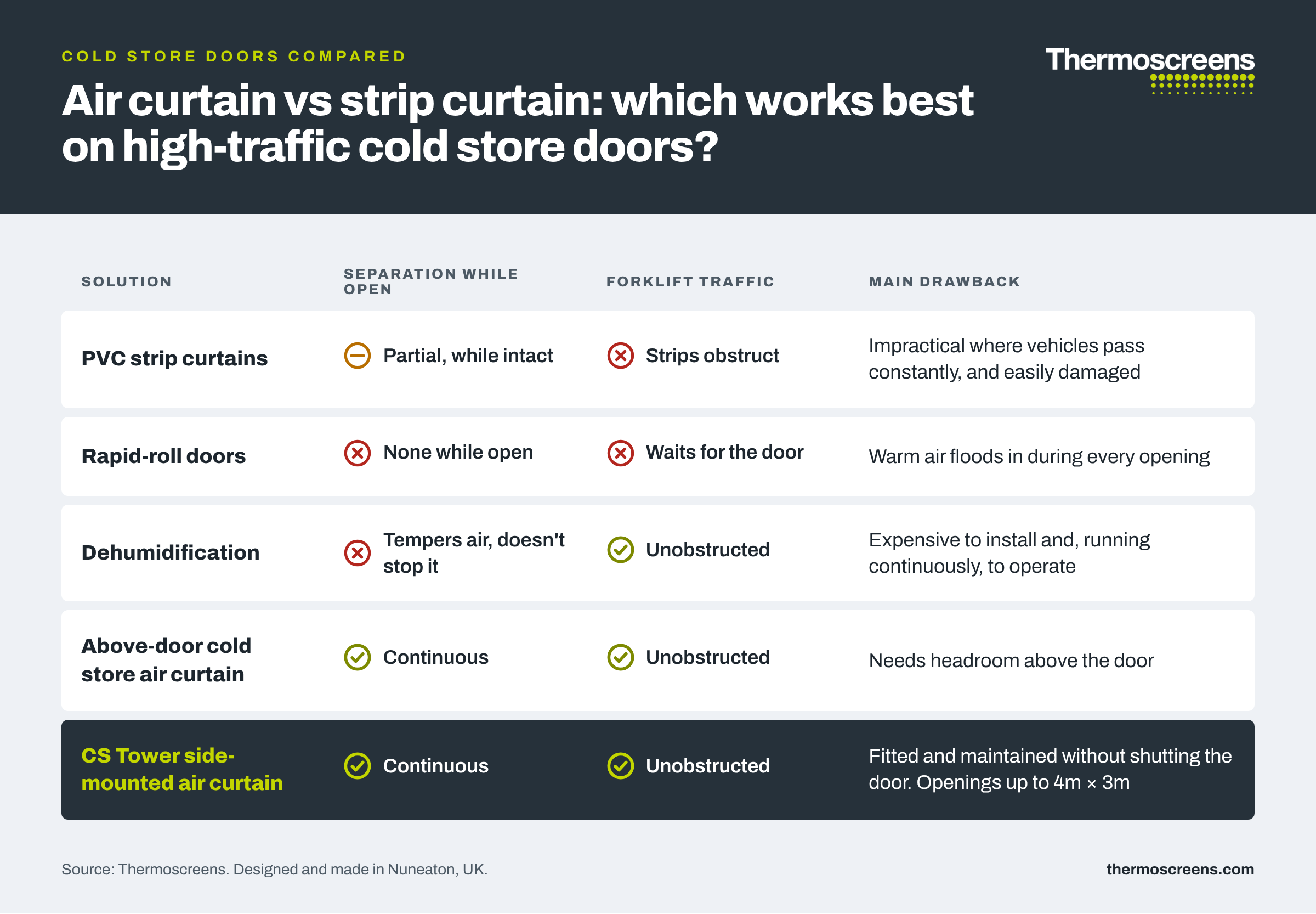
The common thread is that physical barriers trade separation for access. Dehumidification avoids that trade but treats the symptom, not the cause. An air curtain stops warm, moist air at the threshold and leaves the door clear.
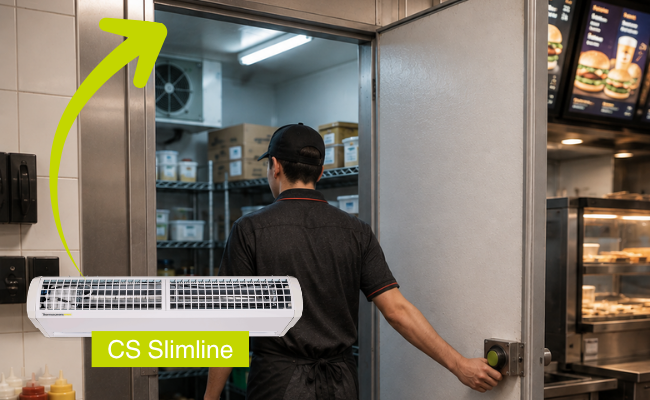
For standard cold rooms and walk-in freezers, the Thermoscreens CS air curtain and Slimline CS are proven above-door options. For the largest, busiest doors in logistics, there is now a purpose-built alternative.
How does the CS Tower stop ice at high-traffic cold store doors?
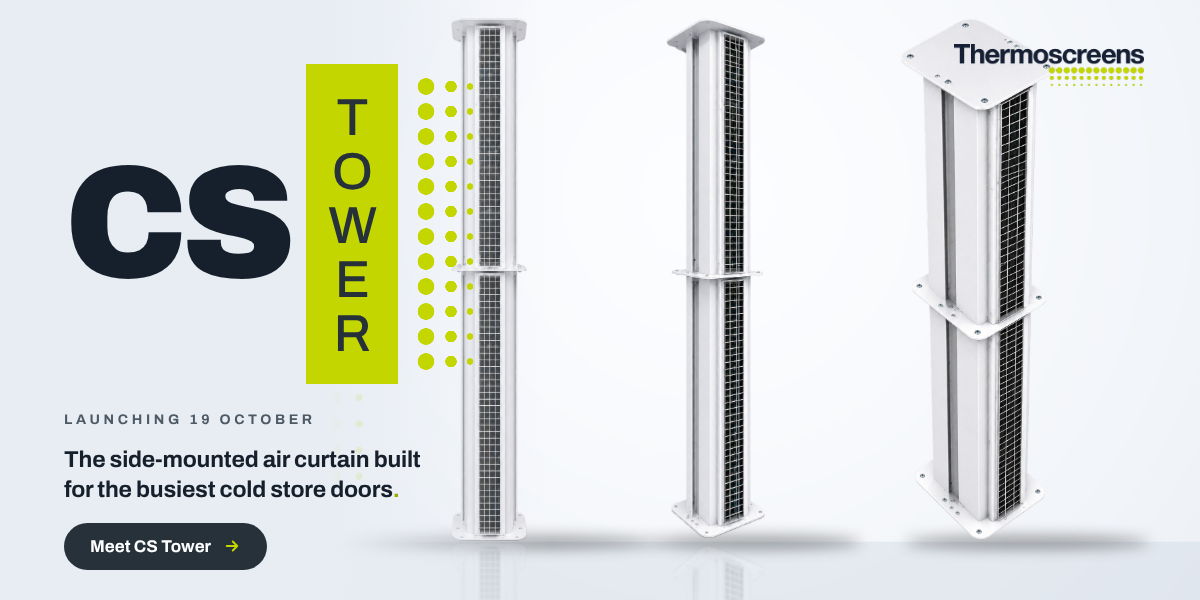
CS Tower is a side-mounted air curtain that stands beside the doorway and puts a barrier of air across it. Warm, moist air stays out, so ice has nothing to form from, and forklifts keep moving.
Thermoscreens launched CS Tower in October 2026 specifically built for the busiest doors in any cold storage warehouse or distribution centre. It was developed over six to nine months with the wider Carver Group engineering team and is built at the company’s factory in Nuneaton.
What makes it different?
- It stands beside the door, not above it. The vertical format lets the unit run at a lower fan speed. It also means the door stays in use while CS Tower is installed and maintained.
- It works on the cold side. Like the rest of the Thermoscreens cold store range, it operates inside the cold store, where many competing units are fitted on the warm side.
- It covers big openings. The first model covers doors up to 4m high and 3m wide, and larger formats are in testing.
- It’s efficient. EC fans draw up to 3.5A single-phase per unit, and airflow is set for each site using the Thermoscreens commissioning guide.
- It fits your controls. Options run from simple plug-and-play to full building management system (BMS) integration through the Thermoscreens control and monitoring package.
- It’s built for hygiene-critical areas. IP66-rated versions can be fully washed down, and stainless steel versions can be chemically cleaned.
- It’s engineered for stability. Units stand up to 4m tall and weigh up to 80kg. In testing, engineers simulated worst-case fan failures, and the structure showed zero loss of balance.
“Operators with large, busy doors have had to choose between strip curtains that get in the way of their trucks and dehumidifiers that are expensive to buy and run. The CS Tower was designed around how these doorways are actually used.” — Chris Collins, Group Sales and Marketing Director, Thermoscreens
CS Tower is already working at its first live site. It joins the Thermoscreens cold chain range alongside the CS, Slimline CS, HE harsh environment and RA air curtains.
What is the ROI of a cold store air curtain?
Recent Thermoscreens testing testing on cold store doors in a cold storage warehouse showed a 13-month return on investment against existing strip curtains. Savings are site-specific, but the evidence across the range is consistent.
- 13 months: the ROI against existing strip curtains, from Thermoscreens’ most recent testing on other cold store doors.
- 4 years: the length of Thermoscreens’ performance data across its cold store range, showing reduced ice formation and improved temperature stability.
- Zero door shutdown: CS Tower is installed and maintained with the doorway still in use, so there’s no lost throughput during fitting.
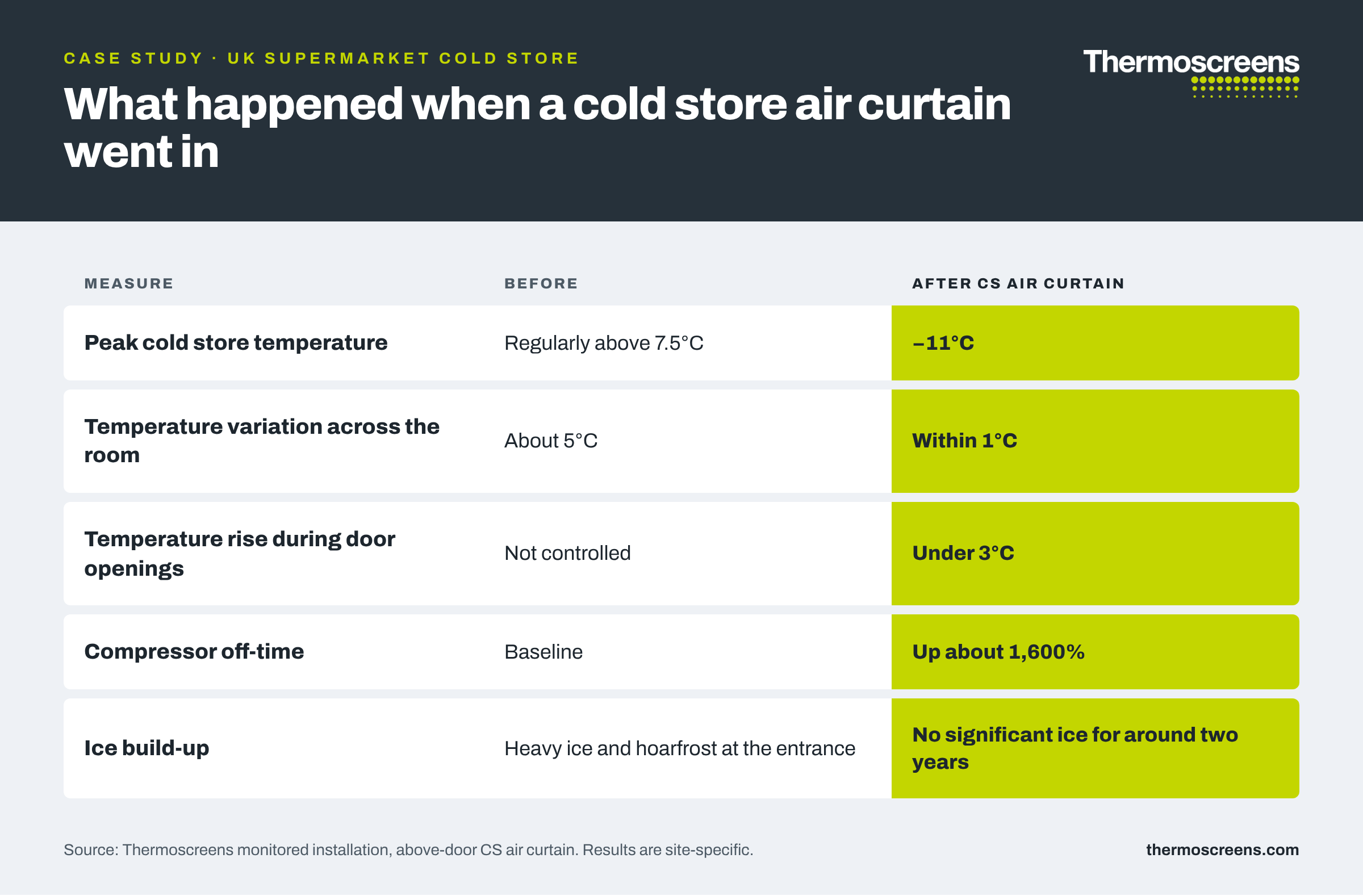
The supermarket cold store case study shows what that looks like in practice with the above-door CS air curtain:
Your payback depends on:
- how often the door opens and for how long
- the temperature and humidity difference across it
- what door protection you have now
- your energy tariff and defrost regime
- what ice is currently costing you in labour, damage and downtime
The Institute of Refrigeration paper suggests air separation becomes worth considering once a door is open for more than 1,000 hours a year. On a busy distribution centre door, that threshold is easy to pass.
Energy is one of the largest controllable costs for cold store operators. Taking load off the refrigeration plant cuts bills and supports net zero targets at the same time.
Frequently asked questions
How do you reduce ice build-up in cold storage?
Stop warm, moist air entering at the doorway. Map your busiest cold store doors, repair seals and strips, cut open time, optimise defrost and fit an air curtain to high-traffic openings.
Why does ice form on cold store floors?
Warm, humid air enters when the door opens, and its moisture condenses and freezes on the cold floor near the threshold. The more often the door opens, the faster ice builds up.
Is an air curtain better than a strip curtain for a cold store?
On high-traffic cold store doors, yes. Strip curtains obstruct forklifts and are easily damaged. An air curtain separates the air continuously and leaves the doorway clear.
Do air curtains work on large cold store doors?
Yes, when they are designed for them. The Thermoscreens CS Tower covers openings up to 4m high and 3m wide, and larger formats are in testing.
What is a side-mounted air curtain?
It’s an air curtain that stands beside a door rather than above it, blowing a barrier of air across the opening. CS Tower’s vertical format runs at a lower fan speed and can be installed without shutting the door.
How quickly does a cold store air curtain pay for itself?
Recent Thermoscreens testing showed a 13-month ROI against existing strip curtains. Savings are site-specific, so a site assessment gives the most accurate figure.
Can air curtains be used in food production cold stores?
Yes. IP66-rated CS Tower versions can be fully washed down, and stainless steel versions can be chemically cleaned for hygiene-critical areas.
Stop ice at your busiest door
Ice in a cold storage warehouse is a doorway problem, and it has a doorway solution. Keep the warm air out and you protect your people, your plant and your stock.
CS Tower was built for exactly that: large, busy cold store doors where traffic can’t stop. It keeps the cold in and the trucks moving.
What is your busiest door costing you? Let’s find out.
Book a site visit with the Thermoscreens cold store team. We’ll look at how your doorways are used and tell you honestly where CS Tower fits. You can also call +44 (0) 24 7638 4646, email sales@thermoscreens.com or contact us online.

Further reading from Thermoscreens:


Testimonials
“We’ve been very pleased with your products and would like to continue using them as a design feature in all our shops.”
- Project Manager, large ice-cream manufacturer.
“Wrapped up and gone before the lunch service, great turnaround from order to delivery.”
- Director, Restaurant in Aldwych
“Thank you for having an excellent working relationship with me, you are a credit to Thermoscreens.”
- Technical Engineer, HVAC
“The new air curtains in the freezer room have completely eliminated any ice and frost build up around the room, including the evaporators. As the main reason for cold room failure, this will undoubtedly help to reduce costly downtime, stock loss and maintenance calls.”
- Refrigeration Manager at leading supermarket
“The units we installed at Birmingham this week. We really enjoyed installing your units and would like to use them moving forward with the other stores.”
- Installer, Restaurant in Birmingham
“I would like to take this opportunity to thank you all for your performance, we have all been very impressed with your response to queries and turnaround of air curtains.”
- Installer, HVAC
“Thank you for all your support. We couldn’t have won this project without your assistance.”
- Senior engineer