Why Is Your Shop Still Cold When the Heating Is On?.
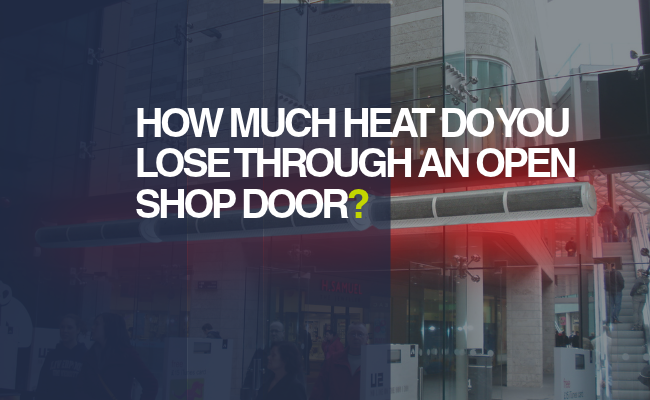
Short answer: If your shop is still cold with the heating on, the most likely cause is your entrance. An open or busy shop door lets warm air pour out and cold air rush in, often faster than your shop heating can replace it. Turning up the thermostat usually just raises the bill. A correctly specified air curtain at the door tackles the cause, not the symptom.
It’s November. Your heating has been on since opening. Customers are still browsing in their coats, and the team on the till are wearing fleeces under their uniforms.
You’re not imagining it, and you’re far from alone. Across UK high streets, retailers ask the same question every winter: why is my shop cold with the heating on? Nine times out of ten, the answer is standing open at the front of the store.
This guide explains where the heat is going, why cranking up the thermostat rarely fixes it, and what to check at your entrance first. For more than 50 years, Thermoscreens has engineered entrance climate separation for retailers ranging from convenience stores to Fortnum & Mason. This is what we’ve learned.
Key takeaways
- The door is the biggest leak. Thermoscreens’ analysis, aligned with CIBSE Guide A, puts open doorways at 60–80% of a retail building’s heating or cooling loss (Thermoscreens Retail Brochure).
- Turning up the thermostat costs more. The Carbon Trust estimates heating costs rise by about 8% for every 1°C of overheating (IEMA / Carbon Trust).
- Your staff need warmth too. HSE guidance puts the indoor workplace minimum at 16°C for mostly sedentary work (HSE).
- Air curtains are a recognised fix. ASHRAE Standard 90.1-2019 accepts tested air curtains as an alternative to entrance vestibules (Construction Specifier).
- Specification matters more than having one. An undersized, badly controlled or poorly maintained over door heater can waste energy rather than save it.
Why is my shop cold when the heating is on?
If your shop is cold with the heating on, your heating system is probably working fine. The problem is that it’s fighting a losing battle against air infiltration, which means outside air entering the building in an uncontrolled way.
Five things usually cause it:
- The open door. Warm air is lighter than cold air. When the door is open, warm air escapes at the top of the opening and cold air floods in along the floor. That’s why customers’ ankles feel the chill first.
- Wind pressure. On an exposed or corner site, wind pushes cold air straight through the entrance and deep into the shop floor.
- Stack effect. In tall units, multi-floor stores and shopping centres, rising warm air draws cold air in at ground level, even when the door is only opening and closing.
- Heat stratification. In high-ceilinged stores, warm air collects under the roof, well above the people who need it.
- Thermostat placement. If the sensor sits somewhere warm, such as the back office or next to a radiator, your system thinks the shop is warm when the sales floor isn’t.
The common thread is that most of these problems start at, or are made worse by, the entrance.
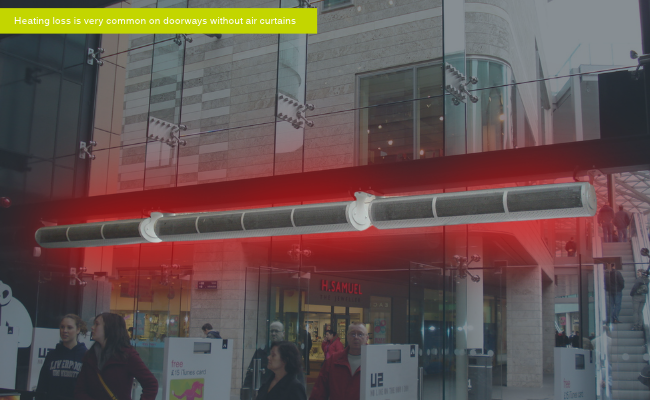
How much heat do you lose through an open shop door?
More than most retailers expect, and it’s the main reason a shop stays cold with the heating on.
- Thermoscreens’ analysis estimates £1,500–£4,000 of wasted heating each year from a single open doorway in a typical 200m² UK retail unit (Thermoscreens Retail Brochure).
- Research by the University of Cambridge’s Department of Engineering, commissioned by the Close the Door campaign, found that closing a shop door while the heating is on can reduce energy use by up to 50% (Close the Door).
- Research commissioned by the Air Movement and Control Association (AMCA) found that air infiltration can account for up to 18% of total heat loss in commercial buildings, and that it matters most where doors are used often, as in retail stores and supermarkets (AMCA Air Curtain Study).
Put simply, heat loss through a shop door is often the single largest line item in your winter heating bill, and it doesn’t appear anywhere on the invoice.
Will turning up the thermostat fix it?
Usually, no. When a shop feels cold with the heating on, cranking up the thermostat is the most common reaction and the most expensive one.
When warm air is escaping through the door, raising the set point just means your system heats more air for the street. You’ll see:
- Higher bills. The Carbon Trust estimates heating costs rise by roughly 8% for each 1°C of overheating (IEMA / Carbon Trust).
- Uneven comfort. The back of the shop becomes stuffy while the entrance and till stay cold.
- Unhappy staff. Your team works in the coldest spot all day.
- A worse customer experience. Shoppers moving between a draughty front and a hot back don’t stay long.
Practical rule: fix the leak before you add heat.
What’s the minimum working temperature for UK shop staff?
The Workplace (Health, Safety and Welfare) Regulations 1992 require a “reasonable” indoor temperature. The HSE’s Approved Code of Practice says this should normally be at least 16°C, or 13°C where work involves rigorous physical effort (HSE).
Retail till and floor work is mostly light activity, so the 16°C benchmark applies. Staff who stand next to an open entrance all shift are the most likely to fall below it.
There’s no fixed legal cut-off, but employers are expected to assess temperature as a workplace risk and act on it. Your entrance is the obvious place to start.
Should retailers just close the door?
It’s a fair question, and the honest answer is: it depends on your entrance and your trade.
The case for closing the door: The Cambridge research shows closing the door cuts heating energy significantly. The same programme also found no conclusive evidence that a closed door affected footfall or transactions, although the researchers noted the sample was limited (Close the Door).
The case for an open door policy in retail: Many retailers, particularly fashion, grocery convenience and high-footfall chains, see an open entrance as part of the brand. They believe it reduces the barrier to entry for passing trade, especially for shoppers with buggies, wheelchairs or full hands.
Thermoscreens frames this as three options:
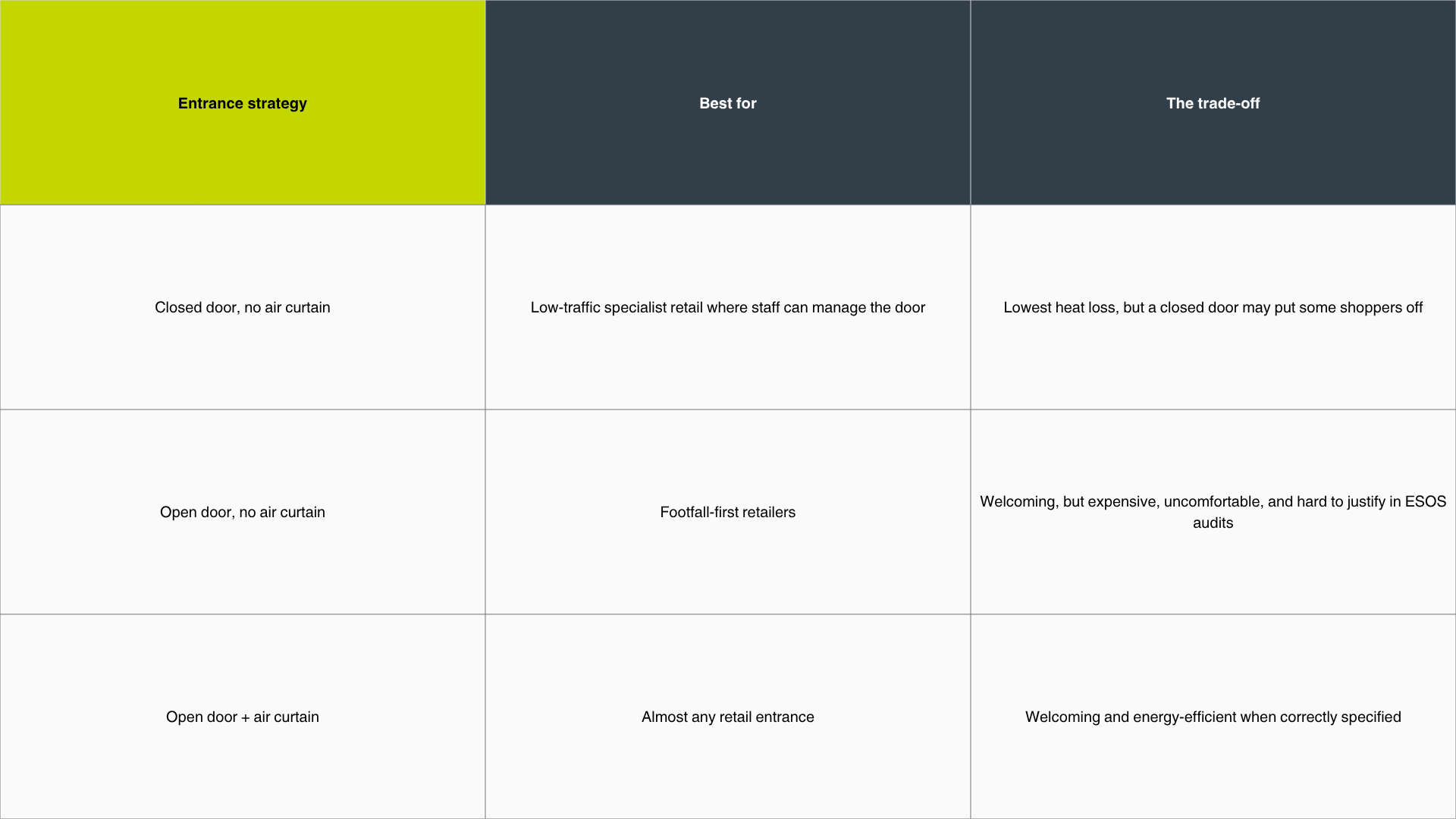
If you want to keep your shop warm with the door open, or your door simply opens hundreds of times an hour, an air curtain closes the gap between those two strategies.
How do air curtains work?
An air curtain sits above (or beside) your doorway and projects a controlled, high-velocity jet of air downward across the opening. That jet acts as an invisible aerodynamic seal:
- Warm air stays in. The jet blocks the natural outflow of heated air at the top of the doorway.
- Cold air stays out. It resists the inflow of cold air at floor level, along with wind, dust, fumes and flying insects.
- The entrance stays open. Customers walk straight through with no physical barrier.
For UK retail, air curtains are usually heated (electric, low-pressure hot water or heat pump), so customers step into warmth rather than a draught.
Air curtain or over door heater: what’s the difference?
People often use the terms interchangeably, but there’s an important distinction:
- A basic over door heater mainly blows warm air into the entrance area. If its jet doesn’t reach the floor with enough velocity, it heats air that walks straight out of the door.
- A properly engineered air curtain is designed first for climate separation, meaning a consistent jet across the full height and width of the opening. Heat is the supporting act.
This is why the Cambridge study found that an open door combined with air curtains and extra heating could still increase energy use. A unit that is undersized, has the wrong discharge velocity, or runs flat out all day with no controls will waste energy. Correct specification, commissioning and controls are what make the difference.
[Image: Thermoscreens air curtain above a retail entrance. Alt text: Thermoscreens heated air curtain above a shop entrance, helping keep a shop warm with the door open]
Are air curtains actually effective?
Yes, when they’re tested and specified properly.
- Code recognition. ASHRAE Standard 90.1-2019 allows doorway air curtains as an alternative to vestibules on most commercial entrances, provided they’re tested to ANSI/AMCA Standard 220 and deliver a minimum airstream velocity at the floor (Construction Specifier).
- Independent testing. Correctly specified Thermoscreens air curtains have been independently tested to EN 16101:2012, the European air curtain performance standard, showing substantial reductions in entrance infiltration loss (Thermoscreens Retail Brochure).
- Comfort as well as cost. A stable entrance temperature means staff near the door and till work in reasonable conditions, and customers stay in your store longer.
What should retailers check before turning up the thermostat?
Run this entrance audit whenever your shop is cold with the heating on, before you touch the controls or call out a heating engineer.
- Do a thermal walk. Stand at the entrance, then at the till, then at the back of the store. If you can feel the temperature drop as you move towards the door, the entrance is your problem.
- Watch your door habits. How often does the door open per hour at peak? Is it propped open all day? Automatic doors on a busy street can be open almost continuously.
- Inspect your existing over door heater. Does the airflow reach the floor? Hold a strip of paper at ankle height to check. Is the unit the full width of the opening? When were the filters and fans last cleaned? A clogged unit loses velocity fast. Is it running on maximum heat with no controls?
- Check your controls. A door switch that runs the air curtain only when the door opens, plus thermostatic control, can make a big difference to running costs. Ask whether your unit can link to your BMS.
- Find the thermostat. Make sure the sensor reflects the sales floor, not the stockroom.
- Consider your site. Corner plots, wind tunnels between buildings, shopping centre malls and tall glazed atria all change what your entrance needs. Mounting height matters too: Thermoscreens’ high-throw PHV and HX Series serve openings up to 4.5m.
- Look at your compliance picture. Entrance infiltration is routinely flagged in ESOS audits, and Building Regulations Part L expects energy waste to be minimised. Fixing the door helps on both fronts.
What is the ROI of a retail air curtain?
Savings are site-specific, but the numbers add up quickly:
- Thermoscreens’ ROI calculations and multi-site retailer benchmarks show a typical payback period of 6–24 months for a retail air curtain at current UK commercial energy tariffs (Thermoscreens Retail Brochure).
- If one open doorway wastes £1,500–£4,000 a year, recovering even half of that loss returns £750–£2,000 per entrance, per year. (Illustrative only. Your figures will depend on door size, footfall, exposure and tariff.)
- Multiply that across a portfolio, and retail air curtain payback becomes a board-level energy story.
Alongside the bill savings, there are less visible returns: fewer staff complaints, longer customer dwell time, cleaner entrances, fewer insects, and a stronger ESG position.
Which Thermoscreens air curtain is right for my shop?
That depends on your entrance width, height, exposure, heating source and how much of the unit you want to see.
- T Series: the industry standard for commercial and retail entrances, from convenience stores to mid-size department stores.
- Surface-mounted air curtains: fixed above the door for fast, straightforward installation.
- Recessed air curtains: hidden in the ceiling so only the grille shows. Ideal for premium store fronts.
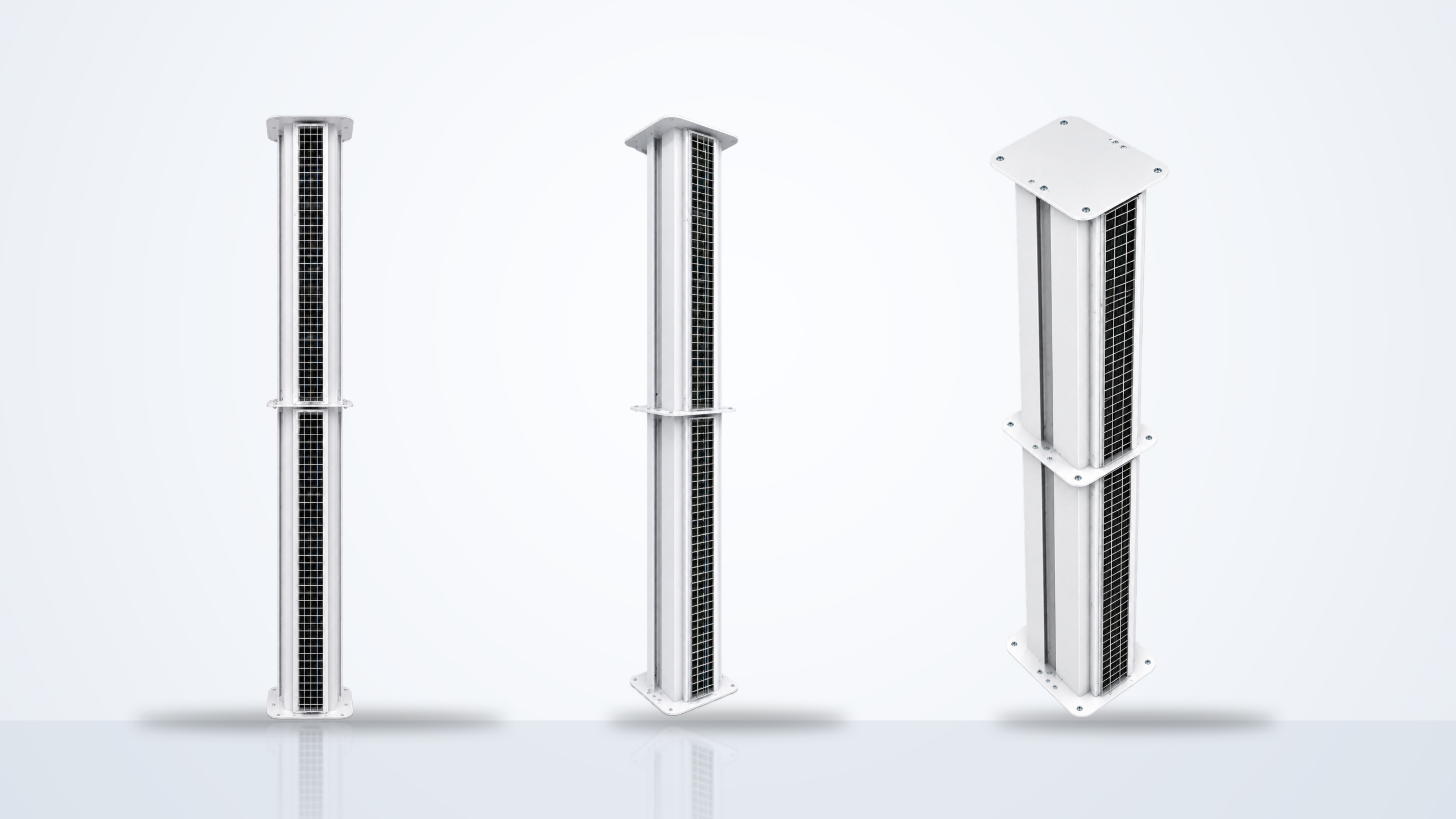
- High-throw PHV and HX Series: for tall entrances and shopping centre units up to 4.5m.
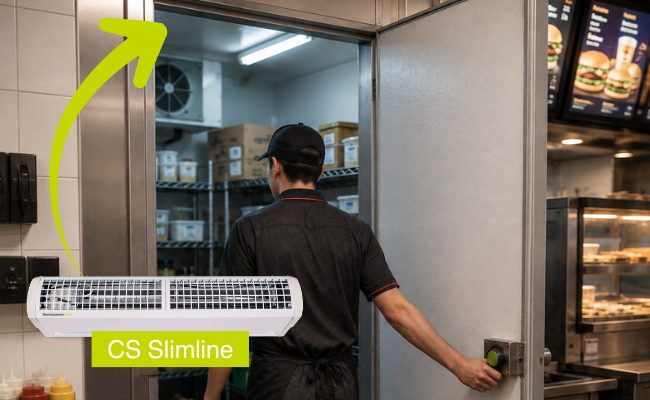
- CS Air Curtain: for supermarket chillers and cold rooms, as a barrier-free alternative to PVC strip curtains.
Case study: When Fortnum & Mason needed to separate indoor and outdoor climates without compromising its landmark building, Thermoscreens designed a bespoke combination of air curtains around existing ceiling voids and BMS plans. The result was reduced draughts and better comfort for customers, and the system protected temperature-sensitive displays. See more retail case studies.
Not sure where to start? Use our product selector or read more about how air curtains work.
Frequently asked questions
Why is my shop cold even with the heating on? Usually because warm air is escaping through the entrance faster than your shop heating can replace it. Open doors, wind, stack effect and poorly placed thermostats are the main causes. Fix the entrance first.
How much heat is lost through an open shop door? A lot. Thermoscreens estimates open doorways cause 60–80% of a retail building’s heating or cooling loss, worth £1,500–£4,000 a year from a single doorway in a typical 200m² unit.
Do air curtains really save energy? Yes, when correctly specified, installed and controlled. ASHRAE Standard 90.1-2019 recognises tested air curtains as an alternative to entrance vestibules, and Thermoscreens units are independently tested to EN 16101.
What’s the difference between an air curtain and an over door heater? An air curtain is engineered for climate separation, with a jet that reaches the floor across the whole opening. A basic over door heater mainly adds heat, which can escape through the door if the airflow isn’t strong enough.
Can I keep my shop door open in winter? Yes. A correctly specified heated air curtain lets you keep the shop warm with the door open while cutting entrance heat loss and keeping staff comfortable.
What is the minimum working temperature for shop staff in the UK? HSE guidance says indoor workplaces should normally be at least 16°C, or 13°C for strenuous physical work.
Is an open door policy in retail worth the energy cost? Without an air curtain, it’s expensive. With a correctly specified air curtain, retailers can keep a welcoming open entrance and control heat loss.
How quickly does a retail air curtain pay for itself? Typically within 6–24 months at current UK commercial energy tariffs, according to Thermoscreens’ ROI calculations. Your payback will depend on your site.
Before you reach for the thermostat, look at the door
If your shop is still cold with the heating on, more heat is rarely the answer. Better control of your entrance is.
Thermoscreens has spent more than 50 years helping UK retailers keep the door open and keep the energy in. Our engineers will assess your entrance, calculate your site-specific savings, and recommend the right air curtain for your store.
Book a free site survey · Request a quote · Explore retail air curtains
Prefer to talk? Call 02476 384646 or email sales@thermoscreens.com.

Testimonials
“We’ve been very pleased with your products and would like to continue using them as a design feature in all our shops.”
- Project Manager, large ice-cream manufacturer.
“Wrapped up and gone before the lunch service, great turnaround from order to delivery.”
- Director, Restaurant in Aldwych
“Thank you for having an excellent working relationship with me, you are a credit to Thermoscreens.”
- Technical Engineer, HVAC
“The new air curtains in the freezer room have completely eliminated any ice and frost build up around the room, including the evaporators. As the main reason for cold room failure, this will undoubtedly help to reduce costly downtime, stock loss and maintenance calls.”
- Refrigeration Manager at leading supermarket
“The units we installed at Birmingham this week. We really enjoyed installing your units and would like to use them moving forward with the other stores.”
- Installer, Restaurant in Birmingham
“I would like to take this opportunity to thank you all for your performance, we have all been very impressed with your response to queries and turnaround of air curtains.”
- Installer, HVAC
“Thank you for all your support. We couldn’t have won this project without your assistance.”
- Senior engineer