The Hidden Cost of Ice Build-Up in Cold Chain Warehouses.
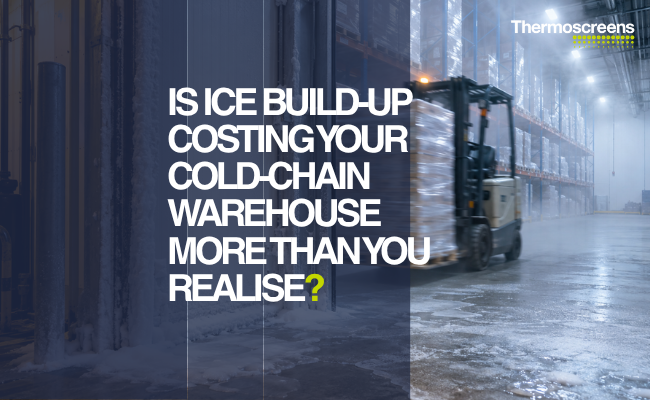
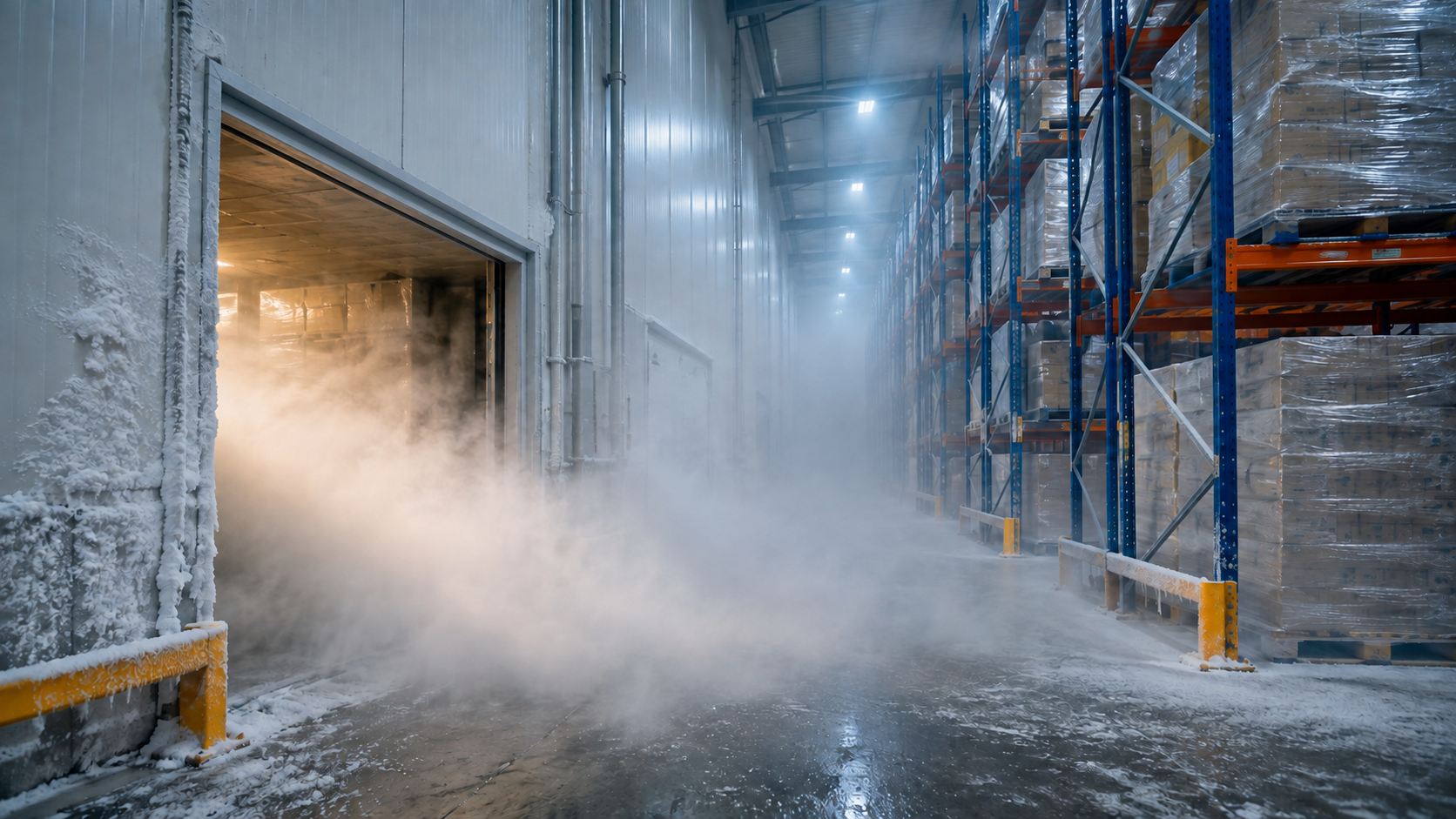
Walk into almost any cold storage warehouse and you’ll see it: a crust of frost creeping up the door frame, ice fused to the floor beneath the evaporator, a maintenance ticket nobody’s got round to. It looks like housekeeping. It isn’t. Ice build-up in cold storage is one of the most under-reported drains on a cold storage warehouse’s running costs — and because it develops gradually, most operators absorb the cost for months, or years, before anyone traces it back to the doorway.
This article breaks down exactly where that cost comes from, what it’s doing to your energy bills, your equipment and your compliance position, and what the evidence says actually works to stop it — grounded in independent industry research and real-site data, not guesswork.
What Causes Ice Build-Up in Cold Chain Warehouses?
Ice build-up happens when warm, humid air from outside a cold store meets the cold surfaces and cold air inside it. Every time a doorway is opened — for a forklift pass, a delivery, a shift change — warm air rushes in and moisture condenses out as the air cools. That moisture settles on evaporator coils, door frames, floors and product racking, then freezes.
The mechanism is straightforward psychrometrics: the colder the store and the more humid the outside air, the faster and more severely ice forms. Left unmanaged, this is not a cosmetic problem — a frozen evaporator coil loses its ability to transfer heat efficiently, forcing the refrigeration system to work harder and cycle more often just to hold temperature.
The two structural causes worth naming:
- Unprotected or poorly protected doorways. Standard doors, worn PVC strip curtains, or doorways left open for operational speed all allow continuous air exchange.
- Inadequate climate separation at the point of entry. Without a purpose-built barrier — mechanical or physical — every door cycle repeats the same moisture-load event.
The Hidden Costs of Ice Build-Up in Cold Storage
Ice build-up rarely shows up as a single line item. It shows up as a pattern of smaller costs spread across several budgets, which is exactly why it’s easy to miss.
1. Energy costs
Ice on an evaporator coil acts as an insulator, blocking the very heat transfer the coil exists to perform. Parts Town’s technical guidance on commercial refrigeration notes that ice build-up on an evaporator coil directly increases energy use and reduces cooling performance, and if left unaddressed can contribute to full system failure. To compensate, refrigeration plant runs longer and defrosts more frequently — and defrost cycles themselves consume significant energy, since much of the heat used to melt ice is dissipated back into the cold store as an additional refrigeration load rather than being fully expelled.
2. Equipment lifespan and maintenance
Frozen fan blades, iced-over door tracks and encrusted seals all accelerate wear. The Air Movement and Control Association (AMCA) has documented that ice build-up from unwanted infiltration directly increases defrost cycling — and more defrost cycles mean more mechanical stress, more callouts, and a shorter service life for refrigeration assets that are expensive to replace.
3. Food safety and product integrity
Temperature stability is the whole point of a cold store. Every door-opening event that lets warm, humid air in creates a temperature spike, and repeated spikes compromise the cold chain — a serious issue under HACCP, BRC and SALSA frameworks, and a direct risk to shelf life and product quality.
4. Health and safety
Ice on floors and door thresholds is a slip hazard. De-icing around doorways is manual, repetitive, and — done incorrectly — a fresh source of standing water and further ice. It’s a recurring labour cost that rarely gets budgeted for separately.
5. Downtime
Frozen door mechanisms, jammed seals and blocked evaporators are among the most common causes of unplanned cold store downtime — and downtime in a cold chain warehouse means stock at risk, not just an inconvenience.
How Does Ice Build-Up Affect Energy Consumption in a Cold Store?
Ice build-up increases energy consumption primarily by forcing more frequent and longer defrost cycles, and by degrading the heat-transfer efficiency of the evaporator coil itself. Independent studies on doorway air control — referenced by ASHRAE, the Carbon Trust, the Institute of Refrigeration and FETA — indicate that an unprotected or poorly protected cold store doorway can allow infiltration losses that a correctly specified air curtain would otherwise reduce by 60–80%.
The Air Curtain Industry Group’s own technical guidance illustrates the scale involved with a worked example: a cold store doorway measuring 2.35m high by 1.8m wide, held at −22°C against a loading bay at +7°C, generates a cooling load of roughly 69kW through infiltration alone. Fitted with a correctly specified air curtain achieving 76.9% effectiveness, that load drops to around 15.9kW — a reduction most facilities managers would recognise immediately on their refrigeration plant’s duty cycle.
That single doorway figure scales across every access point in a warehouse, every shift, every day of the year. It’s why doorway infiltration — and the ice build-up that follows it — is consistently identified as one of the largest controllable loads in cold storage refrigeration.
What Is the ROI of Preventing Ice Build-Up in Cold Storage?
Most sites that fit purpose-built climate separation at cold store doorways see payback within one to three years, according to Thermoscreens’ own monitored installation data. The return isn’t just the electricity saving — it’s a combination of:
- Reduced refrigeration load from lower infiltration, which lowers the energy bill directly.
- Fewer, shorter defrost cycles, which reduces both energy use and mechanical wear on the evaporator.
- Lower maintenance and de-icing labour at doorways and door mechanisms.
- Reduced product loss from temperature excursions.
- Extended plant lifespan, since less thermal cycling means less stress on compressors and fans.
Facilities running doors for more than 1,000 hours a year — typical for a busy distribution warehouse — tend to see the fastest returns, since infiltration losses scale with door-open time. Older or already-strained refrigeration systems also see a disproportionately larger benefit, because reduced load has an outsized effect on plant that’s already working hard.
How to Prevent Ice Build-Up in a Cold Chain Warehouse
Preventing ice build-up means preventing the warm, humid air exchange that causes it in the first place — not just clearing ice after it forms. Three approaches dominate in practice:
Physical doors
Effective when closed, but impractical for doorways with frequent forklift or foot traffic — every opening resets the infiltration event, and high-speed doors add mechanical complexity and their own maintenance burden.
Strip curtains
Low upfront cost, but only work when the strips are intact and the door is genuinely closed behind them. In hygiene-critical cold storage, degraded, torn or grease-marked PVC strips are a recognised contamination risk and a common finding in HACCP audits — our detailed comparison of air curtains vs strip curtains in cold stores goes through the evidence in full.
Air curtains
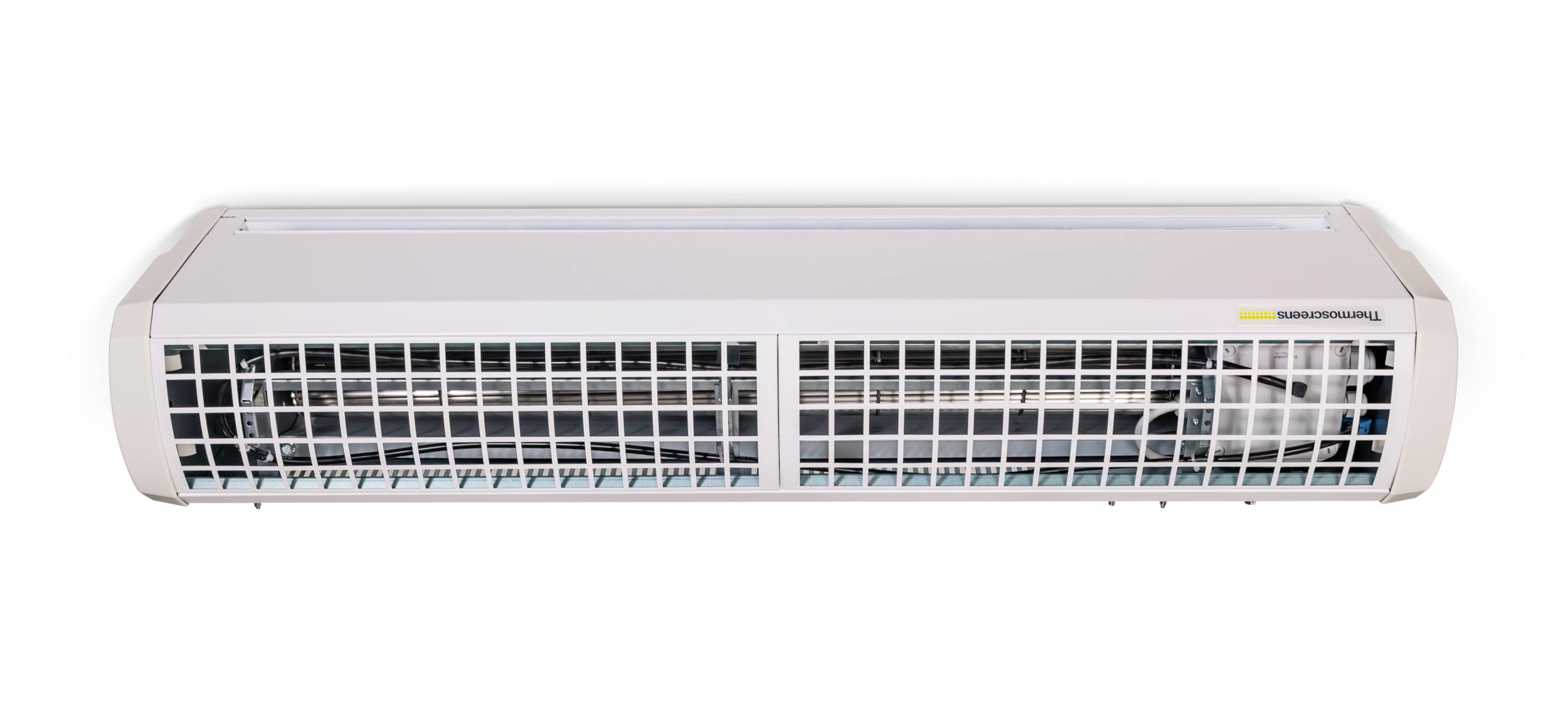
A correctly specified cold store air curtain creates a barrier of high-velocity, temperature-matched air across the full width and height of a doorway — no physical contact, no consumable parts, no degradation over time. Because the barrier works continuously while the door is open (exactly when passive barriers fail), it directly addresses the moisture-load event that causes ice build-up, rather than just tidying up after it.
Thermoscreens’ Cold Chain range includes purpose-engineered units for exactly this job:
- The CS Cold Store Air Curtain is engineered to maintain climate separation down to −25°C, with EC motor technology for energy efficiency and built-in frost protection.
- The Slimline CS Air Curtain delivers the same core performance in a compact form for sites with limited headspace above the door.
Signs of Ice Build-Up on an Evaporator Coil to Watch For
Catching ice build-up early keeps it a maintenance item rather than a capital one. Watch for:
- Visible frost or ice on coil fins, fan blades or the coil housing
- Reduced airflow or a noticeably weaker cold draught from the unit
- Cold store temperature drifting upward despite the refrigeration system apparently running normally
- Water pooling near the unit after defrost cycles
- Increasing frequency of manual or automatic defrost cycles
- Ice forming on door frames, tracks or the floor beneath doorways
Any one of these on its own might be routine. Several together, recurring at the same doorway, point to an infiltration problem rather than a plant fault — and no amount of refrigeration servicing will fix an infiltration problem at the door.
Real-World Results: What Happens When Ice Build-Up Is Addressed
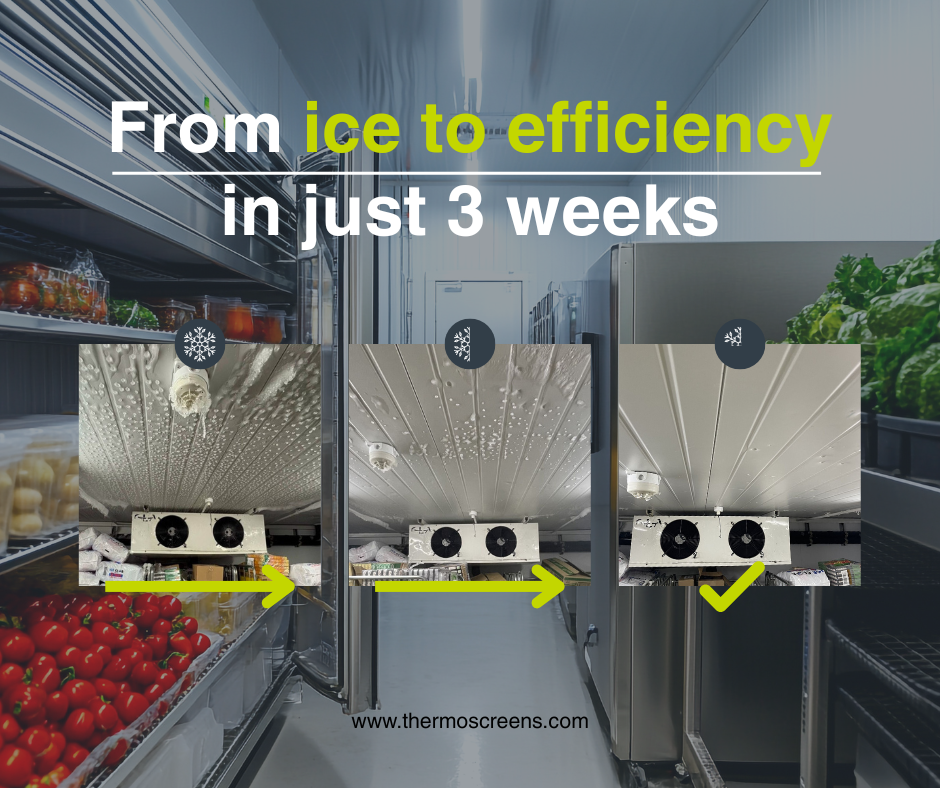
In one Thermoscreens installation at a UK supermarket cold store, monitored data told a clear story. Before the air curtain was fitted, cold store temperatures regularly exceeded 7.5°C during operation, with a temperature difference of around 5°C between different areas of the room. After installation, temperature increases during door openings were reduced to less than 3°C, and, in the customer’s own words, ice and frost build-up around the room and on the evaporators was eliminated entirely.
That matters beyond comfort: uncontrolled ice and frost build-up is widely recognised in the industry as a leading cause of cold room refrigeration failure, which makes its elimination a direct hit on downtime risk, not just a tidier-looking doorway. Read the full case study for the complete before/after data.
Frequently Asked Questions
What causes ice build-up in cold storage warehouses?
Ice build-up is caused by warm, moisture-laden air meeting cold surfaces and cold air inside the store, most often through open or poorly protected doorways. The moisture condenses and freezes on evaporator coils, door frames and floors.
What is the real cost of ice build-up in a cold store?
Beyond the visible ice, the real cost sits in higher energy consumption from extra defrost cycles, accelerated wear on refrigeration equipment, food safety risk from temperature excursions, slip hazards and de-icing labour, and increased risk of unplanned downtime.
How do I prevent ice build-up in a freezer warehouse?
The most effective route is preventing the warm-air infiltration that causes it, typically with a purpose-built cold store air curtain positioned at the doorway. Unlike strip curtains or standard doors, an air curtain maintains a continuous barrier while the doorway is in active use, which is when most infiltration occurs.
How much energy can a cold store air curtain save?
Independent research referenced by ASHRAE, the Carbon Trust, FETA and the Institute of Refrigeration indicates correctly specified air curtains can reduce doorway infiltration by 60–80% compared with an unprotected opening, with some facilities recording energy loss reductions of over 65%.
What is the ROI of an air curtain for cold storage?
Most installations deliver payback within one to three years, based on Thermoscreens’ monitored real-site data, driven by combined savings in energy, maintenance, de-icing labour and reduced product loss — not electricity savings alone.
Do air curtains actually stop ice and frost build-up, not just reduce energy use?
Yes. In monitored installations, purpose-built cold store air curtains have eliminated visible ice and frost build-up around doorways and evaporators, not just improved efficiency metrics — see Thermoscreens’ ROI data from live cold store sites for the full breakdown.
Is an air curtain better than a strip curtain for a cold store doorway?
For doorways with frequent traffic, yes. Strip curtains only function when closed and intact, and degrade over time in ways that create hygiene risk. Air curtains work continuously while the door is open, which is when infiltration and ice build-up actually happen.
Stop Treating Ice Build-Up as a Housekeeping Problem
Ice build-up at a cold storage warehouse doorway is a symptom of a controllable engineering problem, not an unavoidable cost of doing business in the cold chain. The evidence — from independent industry research through to Thermoscreens’ own monitored installations — points the same way: fix the infiltration at the door, and the energy cost, the maintenance cost, and the safety risk fall together.
If ice, frost or rising energy bills are a recurring issue at your cold store doorways, talk to the Thermoscreens Cold Chain team about specifying the right air curtain for your site, or use the product selector tool to get a starting specification in minutes.

Testimonials
“We’ve been very pleased with your products and would like to continue using them as a design feature in all our shops.”
- Project Manager, large ice-cream manufacturer.
“Wrapped up and gone before the lunch service, great turnaround from order to delivery.”
- Director, Restaurant in Aldwych
“Thank you for having an excellent working relationship with me, you are a credit to Thermoscreens.”
- Technical Engineer, HVAC
“The new air curtains in the freezer room have completely eliminated any ice and frost build up around the room, including the evaporators. As the main reason for cold room failure, this will undoubtedly help to reduce costly downtime, stock loss and maintenance calls.”
- Refrigeration Manager at leading supermarket
“The units we installed at Birmingham this week. We really enjoyed installing your units and would like to use them moving forward with the other stores.”
- Installer, Restaurant in Birmingham
“I would like to take this opportunity to thank you all for your performance, we have all been very impressed with your response to queries and turnaround of air curtains.”
- Installer, HVAC
“Thank you for all your support. We couldn’t have won this project without your assistance.”
- Senior engineer