Why Air Curtains Are a Better Alternative to Strip Curtains in Cold Stores.
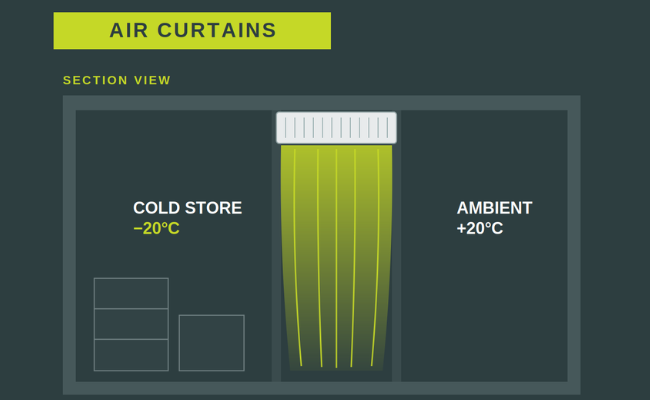
Air curtains for cold stores deliver stronger temperature control, better hygiene and faster return on investment than PVC strip curtains — without obstructing forklift traffic or trapping dirt. If you manage a cold store, freezer room or chilled production line, the doorway is quietly one of your largest sources of energy loss. This guide explains the air curtains vs strip curtains question in plain English, backs it with independent research, and shows why a growing number of UK operators are switching to high-performance air curtains.
Thermoscreens has spent decades engineering doorway climate-separation technology for sub-zero and hygiene-critical environments, and this article distils that expertise into a practical decision framework.
Why the cold store doorway matters more than you think
Every time a cold store door opens, warm, moist air rushes in and expensive chilled air escapes. This single exchange drives a surprising share of total running costs.
- Air infiltration through doorways is one of the largest single sources of heat gain in refrigerated storage rooms.
- Research published in Energy and Buildings found that high-efficiency air curtains can cut heat gains and losses through a cold store door by up to 80% compared with a physical separation solution.
- Separate studies have shown that preventing infiltration can reduce the cooling load by as much as 68%, with compressor power demand falling dramatically once warm-air ingress is controlled.
In short: the doorway is not a detail. It is a major lever on your energy bill, your refrigeration plant’s lifespan, and your ability to hold a stable temperature.
For many years, PVC strip curtains have been the default answer. But “default” is not the same as “best.” See ScienceDirect source
What is the difference between air curtains and strip curtains?
A strip curtain is a passive barrier; an air curtain is an active one. That single distinction explains almost every practical difference between them.
PVC strip curtains are overlapping flexible plastic strips hung across a doorway. They form a physical barrier that people and forklifts push through. They are cheap, simple to install and require little upfront investment.
Air curtains are units mounted above (or beside) the opening that project a controlled, high-velocity stream of air across the doorway. This creates an invisible aerodynamic seal that resists the exchange of warm and cold air — while leaving the opening completely clear.
The key issue with strip curtains is simple: they only work when they are closed. In real production environments, doors and openings are frequently propped, tied back, or have slits cut into the strips for visibility — at which point their effectiveness collapses.
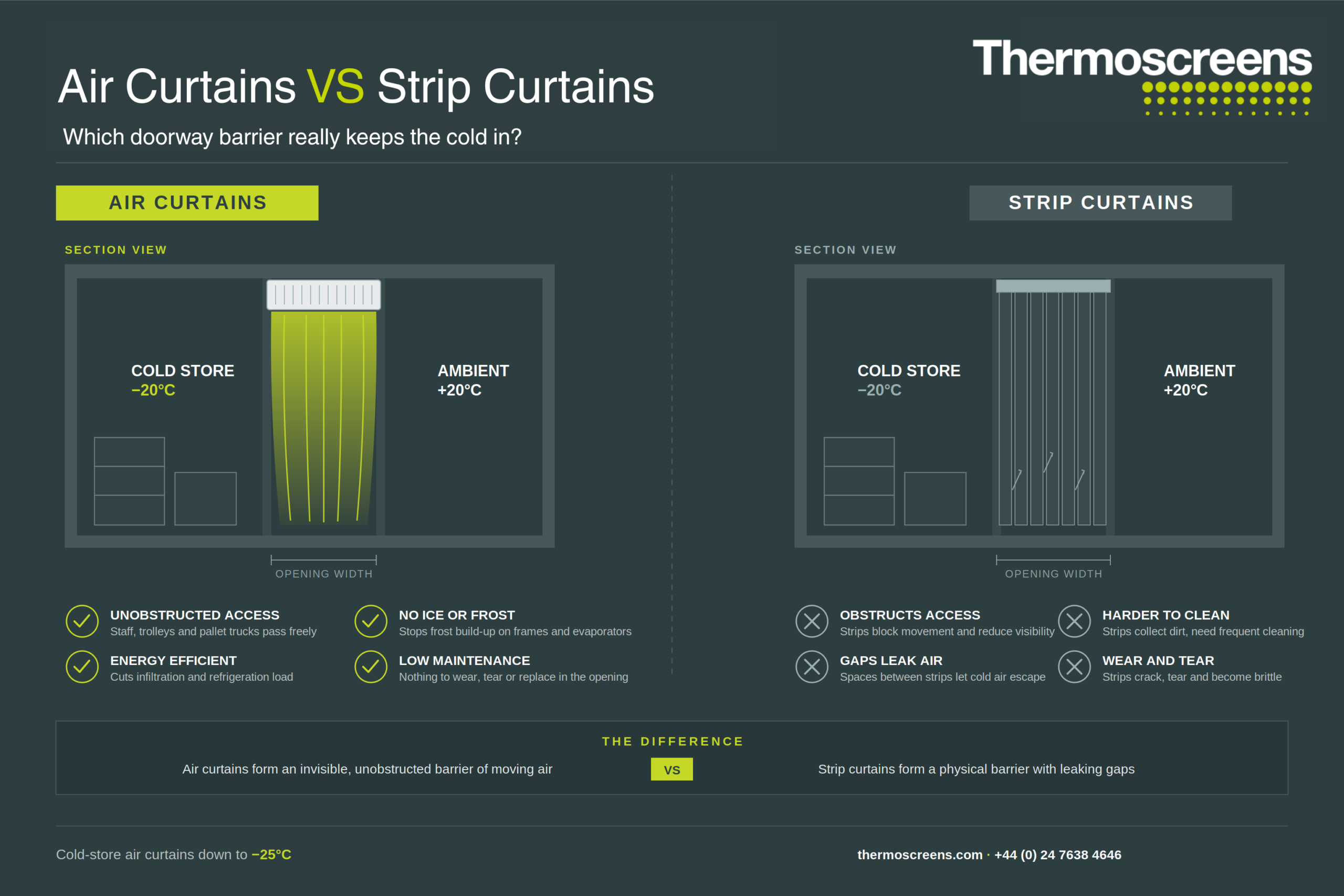
Why are air curtains a better alternative to strip curtains in cold stores?
Here is the answer first, then the detail. Air curtains outperform strip curtains across the metrics that matter most to a cold store operator: energy efficiency, hygiene, workflow, frost control and long-term cost.
1. Superior energy efficiency and climate separation
Strip curtains allow significant air exchange, especially as they wear, warp or are tied back. Air curtains maintain a continuous aerodynamic seal whether traffic is passing or not.
- A UK study by A.M. Foster et al. measured air curtains reducing cold-air infiltration by 60–80% at a cold-room doorway.
- By easing the load on chillers and condensers, air curtains cut energy consumption and reduce wear on refrigeration plant, lowering maintenance and extending equipment lifespan.
This is the heart of cold store energy efficiency: less infiltration means less work for your refrigeration system, every hour of every day.
2. Better hygiene for food production
Strip curtains are notoriously difficult to keep clean. They trap dirt and moisture, and the contact surface is touched by every person and pallet that passes through — a real concern in food-safe and BRC-audited environments.
Air curtains provide a non-contact, hygienic doorway barrier. Nothing physically touches the opening, there are no strips to harbour bacteria, and the airflow itself helps repel airborne dust, fumes and flying insects.
3. Unobstructed workflow and safety
Forklift drivers must physically push through strip curtains, which slows movement, reduces visibility and damages the strips over time. Worn or opaque strips become a genuine safety hazard at busy openings.
Air curtains leave the opening completely clear, improving sightlines, speeding up traffic and reducing the wet floors and ice patches caused by leaking, gapping strips. 3
4. Anti-frost performance in freezer rooms
Warm, humid air entering a freezer doesn’t just cost energy — it forms frost and ice on floors, evaporators and surfaces, driving up defrost cycles, which are among the highest energy loads in any cold store. 7
Modern anti-frost air curtains for freezer rooms are engineered specifically for continuous operation in sub-zero conditions, reducing ice build-up at source and cutting defrost frequency.
5. Lower total cost of ownership
Strip curtains win on purchase price. Air curtains win on total cost. Strip curtains degrade, discolour and need regular replacement; air curtains reduce refrigeration load continuously and pay back the difference.
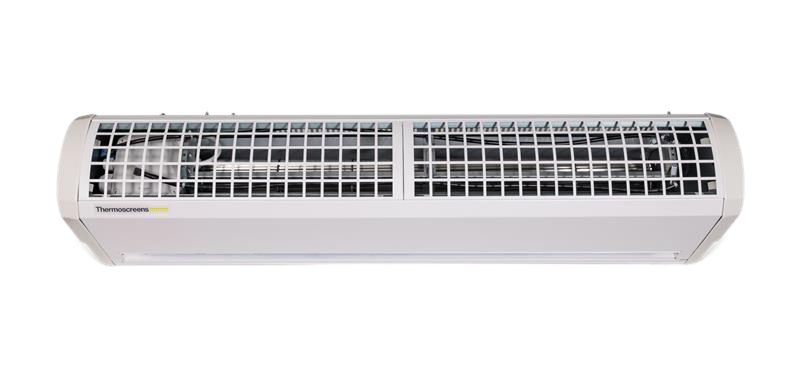
How does an air curtain work in a cold store?
An air curtain uses a fan to draw in air and discharge it through a precision nozzle as a uniform, high-velocity jet across the full width of the opening. This jet meets the floor and splits, with part of the stream recirculating back to the unit.
The result is a stable plane of moving air — an aerodynamic barrier — that resists the natural tendency of warm and cold air to exchange across a temperature boundary. Crucially, this happens without any physical obstruction, so people, pallets and forklifts pass straight through.
In demanding cold store applications, the unit is matched to the door height, the temperature differential, and the traffic level. Correct specification is what separates a high-performing installation from a disappointing one — which is why expert sizing matters.
What is the ROI of air curtains in cold stores?
Most cold store and frozen food facilities see payback within 12–24 months, depending on door size, usage and the temperature differential involved.
The financial case strengthens under exactly the conditions UK operators face today:
- High electricity prices mean every kilowatt-hour saved is worth more.
- Larger temperature differentials (e.g. a freezer opening into an ambient ante-room) increase loss — and therefore increase savings potential.
- Older refrigeration systems benefit most, as reducing their load eases strain and defers costly upgrades.
- High-traffic doorways — where strip curtains fail fastest — are where air curtains deliver the greatest advantage.
Thermoscreens has published real-world ROI data from live cold store sites. You can read the full breakdown in our guide: Do Air Curtains Actually Pay for Themselves? Real ROI Data Explained.
Do you still need strip curtains or doors as well?
Honest answer: sometimes a hybrid approach is best. Nothing beats a sealed, insulated door for total separation when an opening is genuinely not in use — but in practice, cold store doors are opened frequently or left open for operational speed.
Air curtains are highly effective as a stand-alone barrier and even more powerful when combined with high-speed doors or, in some layouts, strip curtains. A well-specified air curtain protects the opening during the long periods when the door is open — which is exactly when passive barriers fail.
For a deeper, application-specific comparison, see our companion article: Air Curtains vs Strip Curtains in Frozen Food Production.
Air curtains vs strip curtains: at-a-glance comparison
| Factor | Air Curtains | PVC Strip Curtains |
|---|---|---|
| Climate separation | Active aerodynamic seal, works door-open | Passive, only works when fully closed |
| Energy efficiency | Up to 80% reduction in door heat exchange | Modest; degrades with wear |
| Hygiene | Non-contact, no harbouring surfaces | Touched by all traffic; traps dirt/moisture |
| Workflow | Completely clear opening | Forklifts must push through |
| Frost/ice control | Anti-frost models reduce build-up | Can leak, gap and form ice |
| Upfront cost | Higher | Lower |
| Total cost of ownership | Lower over time | Higher (replacement + energy loss) |
| Typical payback | 12–24 months | n/a |
Supporting source here
How to choose the right cold store air curtain
A few practical pointers before you specify:
- Match the unit to the door height and width — under-specified units cannot maintain the jet to floor level.
- Account for the temperature differential — freezer-to-ambient openings need purpose-built, anti-frost units.
- Consider traffic intensity — busier openings justify higher-performance models and the strongest ROI.
- Plan for controls integration — pairing with door sensors or high-speed doors maximises savings.
- Specify for hygiene where food safety standards apply.
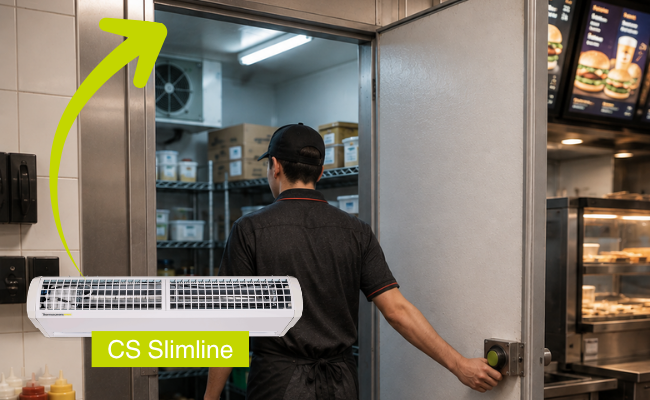
Getting this right is a job for specialists. Thermoscreens engineers cold store air curtains designed specifically for sub-zero environments, frequent door openings and hygiene-critical applications.
Frequently asked questions
Are air curtains better than strip curtains for cold stores?
Yes. For most cold store and frozen food applications, air curtains are a better alternative to strip curtains because they provide active climate separation that works even when the door is open, improve hygiene, keep openings clear for traffic, and deliver measurable energy savings. Strip curtains only seal when fully closed and degrade quickly in high-traffic use.
Do air curtains save energy in cold stores?
Yes. By reducing warm-air infiltration, air curtains lower refrigeration load and energy consumption. Independent research has shown heat exchange through a cold store door can be cut by up to 80% with a high-efficiency air curtain.
What is the ROI of a cold store air curtain?
Many cold store and frozen food facilities see payback within 12 to 24 months, depending on door size, usage and temperature differential. High electricity prices and large temperature differences shorten the payback period further.
Do air curtains work in freezer rooms?
Yes. Anti-frost air curtains are engineered for continuous operation in sub-zero freezer environments, reducing ice build-up on floors and surfaces and cutting energy-intensive defrost cycles.
Are air curtains more hygienic than strip curtains?
Yes. Air curtains are a non-contact barrier with no surfaces to harbour dirt or moisture, making them well suited to food production and hygiene-critical sites. Strip curtains are touched by all passing traffic and can trap contaminants.
Can I use an air curtain alongside strip curtains or high-speed doors?
Yes. Air curtains perform well alone and even better as part of a hybrid system with high-speed doors or strip curtains, protecting the opening during the long periods when the door is open.
A strategic upgrade, not just a doorway accessory
The evidence is consistent across independent studies and live installations: for the way modern cold stores actually operate — frequent openings, high traffic, strict hygiene and rising energy costs — air curtains are a better alternative to strip curtains. They protect temperature stability, cut refrigeration load, improve hygiene and safety, and typically pay for themselves within two years.
Ready to find out how much your cold store could save? Thermoscreens engineers high-performance air curtains built specifically for cold storage and frozen food environments. Contact our team for expert specification advice or request a free energy-saving calculation for your site.

Testimonials
“We’ve been very pleased with your products and would like to continue using them as a design feature in all our shops.”
- Project Manager, large ice-cream manufacturer.
“Wrapped up and gone before the lunch service, great turnaround from order to delivery.”
- Director, Restaurant in Aldwych
“Thank you for having an excellent working relationship with me, you are a credit to Thermoscreens.”
- Technical Engineer, HVAC
“The new air curtains in the freezer room have completely eliminated any ice and frost build up around the room, including the evaporators. As the main reason for cold room failure, this will undoubtedly help to reduce costly downtime, stock loss and maintenance calls.”
- Refrigeration Manager at leading supermarket
“The units we installed at Birmingham this week. We really enjoyed installing your units and would like to use them moving forward with the other stores.”
- Installer, Restaurant in Birmingham
“I would like to take this opportunity to thank you all for your performance, we have all been very impressed with your response to queries and turnaround of air curtains.”
- Installer, HVAC
“Thank you for all your support. We couldn’t have won this project without your assistance.”
- Senior engineer