Why Strip Curtains Could Be Costing Your Cold Store Thousands.

If your cold store still relies on PVC strip curtains, there’s a good chance they’re quietly driving up your cold storage energy costs every single day — not through one dramatic failure, but through hundreds of small ones. A gap here. A torn strip there. A forklift that’s cut a section away for “better visibility.” None of it looks like a problem on the shop floor. On your energy bill, it adds up fast.
For facility managers, engineers, and operations directors running cold stores, freezer rooms, or blast chill environments, doorway protection isn’t a minor spec line, it’s one of the biggest controllable variables in your refrigeration running costs. This article breaks down exactly how strip curtains lose you money, what it means for hygiene compliance, and how strip curtains vs air curtains actually compares when you look at total cost of ownership rather than sticker price.
How Much Energy Do Cold Store Doors Really Lose?
Doorways are the single biggest source of unplanned heat gain in most cold storage facilities. Every time a door opens, warm, humid air rushes in at the top of the opening while cold, dry air sinks out at the bottom — a process known as convection or “air flooding.” Industry design guidance puts convection losses at up to 85% of the total energy loss associated with door openings, making it by far the largest controllable factor in refrigeration load.
Refrigeration itself typically accounts for 30–40% or more of total operating costs in a cold storage facility, so even modest reductions in door-related heat gain translate directly into bottom-line savings. Facilities relying on outdated or poorly maintained doorway barriers commonly spend 20–30% more on energy annually than sites using modern, well-specified alternatives.
A strip curtain, in theory, exists to stop exactly this. In practice, its performance degrades the moment it’s installed.
Why Do Strip Curtains Lose Effectiveness So Quickly?
Strip curtains work on a simple principle: overlapping PVC strips form a physical seal that goods and people push through. When new, a well-fitted strip curtain does a reasonable job of separating temperature zones. The problem is what happens next.
In real-world cold storage operations, strip curtains routinely suffer from:
- Physical damage — forklift traffic warps, tears, and eventually shreds the strips, especially at the base
- Deliberate modification — strips get tied back, cut short, or removed altogether by staff trying to improve visibility or speed up throughput
- Loss of overlap — as strips age and stiffen, the seal between them opens up, allowing continuous air exchange even when “closed”
- Repair costs — collision damage from reduced visibility can run into the thousands each time a door or curtain assembly needs replacing
Once a strip curtain is damaged or propped open, it stops functioning as a barrier at all, but it keeps looking like one, which is often the most expensive part of the problem. Nobody notices the leak because there’s still a curtain hanging in the doorway.

What’s the Hygiene Risk of PVC Strip Curtains in Cold Storage?
Beyond energy, strip curtains carry an often-overlooked food safety risk. Because strips make direct physical contact with every pallet, trolley, and forklift that passes through, they act as a contact surface for whatever is on those surfaces – grease, product residue, and moisture. Guidance on cold room hygiene notes that PVC strips can collect dust, grease, and food spillages, requiring a dedicated cleaning schedule to remain hygienic — a schedule that, anecdotally, is one of the first things to slip under operational pressure.
The moisture dimension matters too. Damp, chilled conditions are exactly where pathogens like Listeria monocytogenes thrive, and condensation is a direct consequence of warm, humid air infiltrating a cold environment — precisely what a failing strip curtain allows. For anyone running a HACCP-audited site, a visibly degraded, grease-marked strip curtain sitting between clean and dirty zones is a difficult thing to defend during an audit – Thermoscreens has covered this specific risk in the context of chilled food environments, including a recent trial with DO & CO in a high-risk chiller environment.
None of this means every strip curtain installation is unsafe. Food-grade PVC exists precisely to meet contact-material regulations. But it does mean strip curtains introduce a hygiene management burden that a non-contact barrier simply doesn’t have.
How Does an Air Curtain Work as an Alternative?
An air curtain creates an invisible barrier of high-velocity, temperature-matched air across a doorway. Rather than relying on a physical strip that people and vehicles must push through, the air stream itself resists the exchange of warm and cold air, letting forklifts, pallets, and staff move through completely unobstructed.
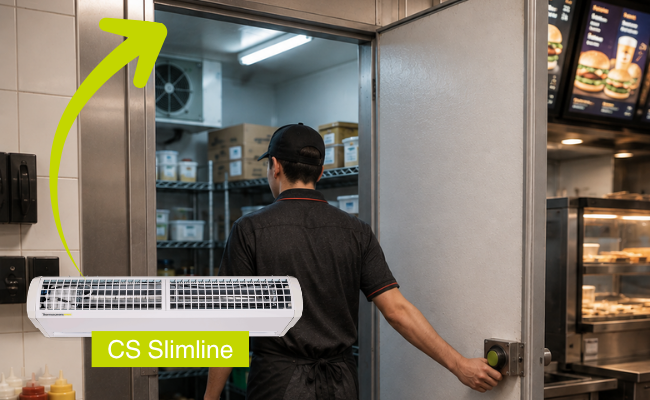
Thermoscreens’ Cold Store (CS) range, for example, is engineered specifically for this job: positioned inside the cold store, it recirculates ambient air through energy-efficient EC fans to form a consistent thermal barrier, down to temperatures as low as -25°C. Because there’s no physical contact between goods and the barrier, there’s no strip to tear, warp, or contaminate — and no cleaning schedule for the barrier itself.
Independent research on doorway air control, including studies referenced by ASHRAE and the Carbon Trust, indicates that correctly specified air curtains can reduce cold air infiltration by 60–80% compared with an open, unprotected doorway. Industry guidance from the Institute of Refrigeration and FETA similarly points to energy loss reductions of over 65% in facilities where cold store doors are open for more than 1,000 hours a year.
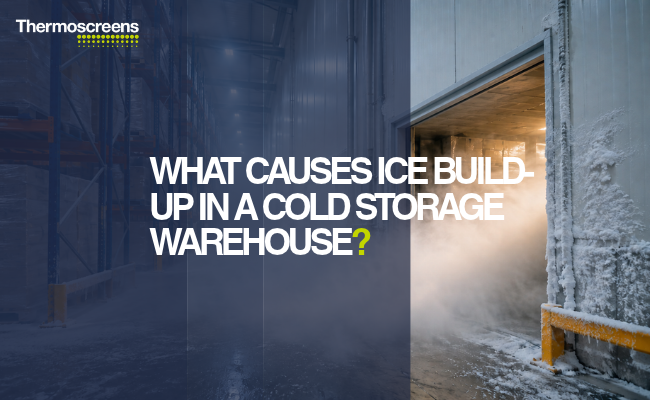
Air curtains also address the two operational headaches strip curtains create: forklift downtime from pushing through strips, and ice and frost build-up caused by moisture infiltration. Thermoscreens has previously written in detail about how ice and frost form in cold stores and how to reduce it — a problem strip curtains actively contribute to rather than solve.

What’s the ROI of Switching from Strip Curtains to an Air Curtain?
This is the question that actually matters to anyone signing off the capital spend. Air curtains cost more upfront than strip curtains — that’s not in dispute. What changes the calculation is total cost of ownership over the life of the installation.
Strip curtains have a lower purchase price but accumulate ongoing costs: strip replacement from wear and forklift damage, cleaning labour, and the energy loss of a barrier that’s rarely performing at spec once it’s been in use for a few months. Air curtains have a higher installation cost but a materially lower run-rate: no consumable strips to replace, no barrier-specific cleaning regime, and consistent – rather than degrading, thermal performance over time.
With UK electricity costs remaining high, the energy-saving side of that equation compounds quickly, and older or already-strained refrigeration systems tend to see the largest relative benefit from reduced door-opening load. Thermoscreens has published real operational data on this exact question — see Do Air Curtains Actually Pay for Themselves? Real ROI Data Explained for site-level figures on payback periods and defrost-cycle reduction.
Strip Curtains vs Air Curtains: A Side-by-Side Comparison
| Factor | PVC Strip Curtains | Air Curtains |
|---|---|---|
| Upfront cost | Lower | Higher |
| Energy performance over time | Degrades with wear and damage | Consistent, engineered performance |
| Hygiene | Direct product/surface contact; needs dedicated cleaning | No physical contact barrier |
| Forklift traffic | Strips damaged, visibility reduced | Unobstructed, full visibility |
| Ice and frost risk | Contributes to moisture infiltration | Reduces ice/frost formation |
| Ongoing maintenance | Strip replacement, repairs from collisions | Minimal; no consumable parts |
| Best suited to | Low-traffic, infrequently used openings | High-traffic, hygiene-critical, frequently opened doorways |
Worth noting: this isn’t always a binary choice. Some large cold storage operations run air curtains as the primary thermal barrier with strip curtains retained as a supplementary backup on lower-traffic access points — the two technologies aren’t mutually exclusive.
When Do Strip Curtains Still Make Sense?
In fairness to strip curtains, they’re not obsolete everywhere. For openings used infrequently, where budget is the overriding constraint, and where hygiene auditing isn’t a major factor, a well-maintained strip curtain can still be a reasonable, low-cost barrier. The economics shift decisively toward air curtains once you’re dealing with high door-opening frequency, forklift traffic, sub-zero temperatures, or a food safety audit trail that needs to hold up to scrutiny.
How Do You Calculate Your Own Cold Store’s Hidden Costs?
Before specifying anything, it’s worth quantifying what your current doorway is actually costing you:
- Log door-opening frequency and duration. Facilities with doors open more than 1,000 hours a year sit firmly in the range where doorway barriers materially affect energy costs.
- Inspect strip condition properly, not just at a glance — look for warping, torn sections, missing strips, and loss of overlap at floor level.
- Check defrost cycle frequency. Rising defrost frequency is a leading indicator of moisture infiltration and a failing barrier.
- Review maintenance and replacement spend on the current barrier over the past 12 months, including any collision-related repairs.
- Get a site-specific energy assessment. Payback periods vary with climate, door size, electricity tariff, and existing refrigeration condition — a proper site survey turns rules of thumb into a real business case.
Frequently Asked Questions
Do strip curtains increase cold storage energy costs?
Yes. Once damaged, worn, or propped open — which happens quickly under regular forklift and foot traffic — strip curtains stop providing an effective seal, allowing continuous warm-air infiltration that forces refrigeration systems to work harder and increases running costs.
Are PVC strip curtains hygienic for food storage?
Food-grade PVC strip curtains can meet food contact regulations, but because they make direct physical contact with goods, forklifts, and staff, they require a dedicated cleaning schedule to stay hygienic. Grease, residue, and moisture build-up on strips are a recognised contamination risk in cold storage environments.
What is the ROI of switching to an air curtain in a cold store?
Payback varies by site, but studies on doorway air control report infiltration reductions of 60–80% versus an unprotected opening, with facilities operating doors for more than 1,000 hours a year seeing the fastest returns. Real-world payback periods and defrost-cycle data are available in Thermoscreens’ ROI case study.
Can air curtains fully replace strip curtains?
In many high-traffic or hygiene-critical cold stores, yes. Air curtains handle the thermal barrier function without physical contact or consumable parts. Some sites choose to combine both, using air curtains as the primary barrier and strip curtains as a supplementary layer on low-traffic openings.
What temperature range can a cold store air curtain handle?
Purpose-built cold store air curtains, such as Thermoscreens’ CS range, are designed to maintain climate separation down to -25°C, which covers the vast majority of chilled and frozen cold storage applications.
How do I know if my cold store doorway needs an air curtain?
Frequent door openings, visible strip curtain damage, recurring ice or frost build-up, rising defrost cycles, and difficulty passing hygiene audits at the doorway are all signals it’s time for a proper site assessment.
Ready to See What Your Doorway Is Actually Costing You?
If any of this sounds familiar — worn strips, rising energy bills, ice build-up you can’t quite get on top of — it’s worth finding out exactly what your current setup is costing before your next refrigeration bill lands. Speak to Thermoscreens about a site survey, and get a straight answer on whether an air curtain would pay for itself at your facility, and how quickly.


Testimonials
“We’ve been very pleased with your products and would like to continue using them as a design feature in all our shops.”
- Project Manager, large ice-cream manufacturer.
“Wrapped up and gone before the lunch service, great turnaround from order to delivery.”
- Director, Restaurant in Aldwych
“Thank you for having an excellent working relationship with me, you are a credit to Thermoscreens.”
- Technical Engineer, HVAC
“The new air curtains in the freezer room have completely eliminated any ice and frost build up around the room, including the evaporators. As the main reason for cold room failure, this will undoubtedly help to reduce costly downtime, stock loss and maintenance calls.”
- Refrigeration Manager at leading supermarket
“The units we installed at Birmingham this week. We really enjoyed installing your units and would like to use them moving forward with the other stores.”
- Installer, Restaurant in Birmingham
“I would like to take this opportunity to thank you all for your performance, we have all been very impressed with your response to queries and turnaround of air curtains.”
- Installer, HVAC
“Thank you for all your support. We couldn’t have won this project without your assistance.”
- Senior engineer