How to Reduce Condensation and Ice Build-Up in Cold Storage Facilities.
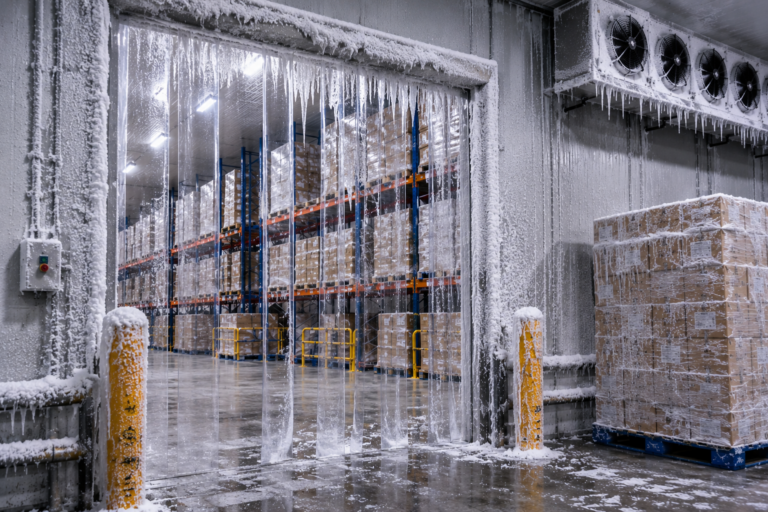
In any chilled or frozen environment, condensation and ice build-up are far more than a cosmetic nuisance. They are a direct drain on energy, a threat to product quality, and a recognised health and safety hazard. For facility managers, cold chain operators and refrigeration engineers, learning how to reduce condensation and ice build-up in cold storage facilities is one of the highest-impact improvements available — often delivering measurable savings within a single year.
The physics are simple but unforgiving. Every time a door opens, warm, humid air floods into the cold space, reaches its dew point, and condenses or freezes on the coldest surfaces it can find: evaporator coils, walls, ceilings, racking and floors. Industry measurements show that opening a cold store door can raise the temperature at the doorway by between 4°C and 10°C each time, forcing refrigeration plant to work harder to recover.
This article explains why frost and condensation form, the real costs they impose, and the proven, practical steps you can take to control them — from vapour barriers and door discipline to the single most effective intervention at the doorway: a purpose-built cold store air curtain.
As specialists in climate separation technology, Thermoscreens has spent decades helping UK cold chain operators protect product, cut energy use and keep their people safe. Here’s what works.
What Causes Condensation and Ice in Cold Storage?
Answer first: Condensation and ice form when warm, moisture-laden air meets a surface colder than its dew point. The water vapour in that air condenses into liquid, and at sub-zero temperatures it freezes into frost and ice.
In a working cold store, this happens continuously. The main drivers are:
- Doorway air exchange – the single largest source. Every door opening lets humid external air rush in as pressures equalise. Doorways are where the greatest energy gains and losses in a cold storage room occur.
- Compromised door seals and gaskets – worn or torn dock seals let moist air leak in even when doors are closed.
- Incorrect vapour barrier placement – a vapour barrier installed on the cold side of insulation (rather than the warm side) traps moisture inside the wall system, causing hidden frost, corrosion and waterlogged insulation.
- Inadequate insulation or panel selection – older EPS panels absorb more moisture than modern closed-cell PIR panels, which barely absorb water and hold their thermal performance.
- Poor refrigeration design or undersized plant – leading to surfaces colder than necessary and aggressive condensation.
Once moisture is inside, it enters a destructive freeze–melt–refreeze cycle that steadily wears down both the building fabric and the refrigeration equipment.
What Problems Do Frost and Ice Cause in a Cold Store?
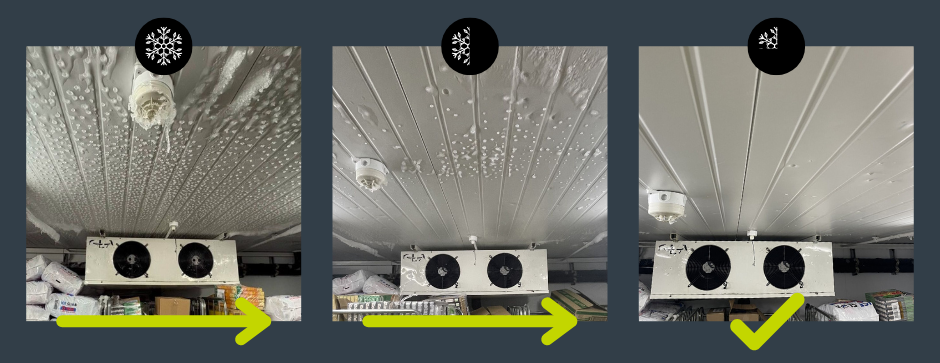
Frost and condensation are sometimes described as “silent efficiency killers” — and the description is apt. The consequences fall into four categories:
1. Higher energy costs. Ice on evaporator coils blocks airflow and cripples heat exchange. As ice thickens, cooling efficiency falls and energy use climbs. To clear it, facilities run frequent defrost cycles — each one adding load and pushing temperatures back up.
2. Product loss and spoilage. Condensation on packaging weakens seals and cartons, while temperature fluctuations shorten shelf life. In one documented retrofit case, products stored near the door had shelf lives 15–20% shorter than expected before air separation was installed.
3. Health and safety risk. Ice on floors creates slip and forklift collision hazards; fog at doorways reduces visibility. Damp environments also encourage mould growth, which carries food safety and respiratory health implications.
4. Building and equipment damage. Persistent moisture corrodes steel components, rots structural woodwork and degrades insulation — shortening the life of expensive assets.
How Do You Reduce Condensation and Ice Build-Up? The 7 Proven Methods
Effective control combines good design, operational discipline and active climate separation. Here are the seven most effective measures, roughly in order of impact.
1. Install a cold store air curtain at the doorway
Because roughly 70% of cold storage energy problems originate at the door, this is the highest-leverage intervention. A correctly specified air curtain projects a high-velocity, calibrated air stream across the opening, creating an invisible barrier that separates the warm and cold zones while keeping the doorway clear for traffic. (More detail in the section below.)
2. Get the vapour barrier right
Always position a continuous vapour barrier on the warm side of the insulation, and seal every joint, seam and penetration. Because moving air carries far more moisture than slow vapour diffusion, airtight sealing stops the majority of the problem before it starts.
3. Upgrade to closed-cell insulation panels
Specify PIR (polyisocyanurate) panels over older EPS. Their closed-cell structure resists water absorption, maintaining steadier temperatures and fewer hidden icy surprises in walls and ceilings.
4. Maintain door seals and dock gaskets
Inspect seals and gaskets weekly for tears and gaps. Small leaks compound quickly into significant frost problems.
5. Control humidity with dehumidification where needed
In high-humidity locations or processes, desiccant dehumidification controls moisture at source, preventing condensation from ever forming. This is especially valuable in ultra-low-temperature stores where heaters alone simply add cooling load.
6. Impose operational discipline
Train staff to minimise door-open time, use airlocks and anterooms correctly, and avoid propping doors. Even with fast-acting doors, aggregate door-open time in a busy store can exceed 1,000 hours per year.
7. Optimise defrost scheduling
Match defrost cycles to actual frost load rather than running them unnecessarily. Reducing moisture ingress at the door directly reduces how often defrost is needed.
How Does a Cold Store Air Curtain Work?
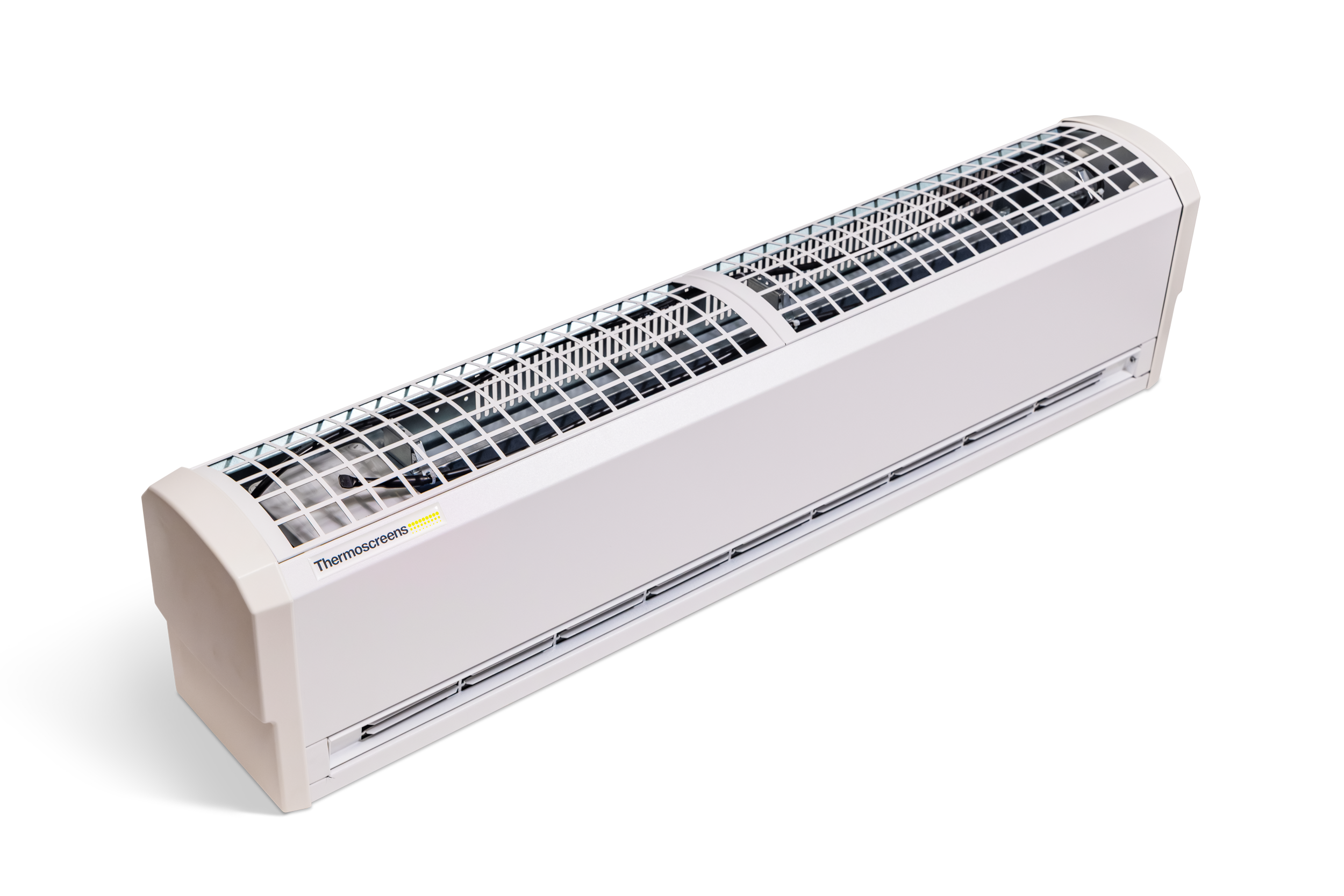
Answer first: A cold store air curtain works by discharging a controlled, high-velocity stream of air across a doorway, forming an aerodynamic barrier that minimises the exchange of air, moisture and temperature between two environments — without obstructing access.
When the doorway is left unprotected, warm air enters at high level while cold air spills out across the floor, a constant convection exchange that wastes refrigeration energy. An air curtain interrupts this exchange. The result is a clear, ice-free doorway and a stable internal temperature.
For sub-zero applications, specialist units include features such as:
- EC motor technology for high energy efficiency and variable speed control.
- Built-in frost protection (anti-frost), essential below -18°C where standard units would freeze and fail.
- Door-switch control, which increases fan speed when the door opens and reduces speed or shuts the unit off when closed.
- BMS interface for integration with central building management and refrigeration controls.
The energy an air curtain saves through reduced refrigeration loss and fewer defrost cycles greatly outweighs the energy it consumes — provided it is correctly sized, positioned close to the opening, and calibrated to the temperature and pressure differential.
What Is the ROI of a Cold Store Air Curtain?
Answer first: Cold store air curtains typically deliver one of the fastest paybacks of any cold chain upgrade, because they target the doorway — the single largest source of energy loss.
The supporting evidence is consistent across independent studies and field data:
- A cold store doorway can see temperature increases of 4°C to 10°C per opening; an air curtain can reduce that to around 1°C, cutting heat loss at the opening by up to 90%.
- Research published in Energy and Buildings (Polytechnic University of Madrid) found high-efficiency air curtains delivered energy savings of over 30% in commercial applications, with shorter payback periods than conventional alternatives.
- Field data from cold storage retrofits reports cold-air infiltration reductions of up to 80% and refrigeration energy reductions of 20% to 40%.
- Hybrid air door systems can achieve 90%+ separation efficiency even while the opening is in use.
Because savings accrue on energy bills, defrost frequency, maintenance and product loss simultaneously, the combined return usually justifies the investment well within the first year of operation.
Are Air Curtains Better Than PVC Strip Curtains?
Answer first: Yes — for most modern cold chain operations, air curtains outperform PVC strip curtains on hygiene, safety, workflow and long-term cost.
Strip curtains physically obstruct the doorway, slow forklift traffic, become brittle and opaque over time, harbour contamination, and require regular replacement. Air curtains provide active climate separation with no physical obstruction — improving traffic flow, visibility and hygiene while supporting sustainability goals by removing single-use plastics from the operation.
For a fuller comparison, see the Thermoscreens guide Air Curtains vs. Strip Curtains: Which Is Right for Your Cold Store?
Choosing the Right Cold Store Air Curtain
Specification should always follow a site assessment, but key considerations include:
- Temperature band — chilled (0–5°C), freezer (below -18°C), or ultra-low temperature. Sub-zero stores require dedicated anti-frost models.
- Doorway dimensions — the air stream must fully span the width and height of the opening.
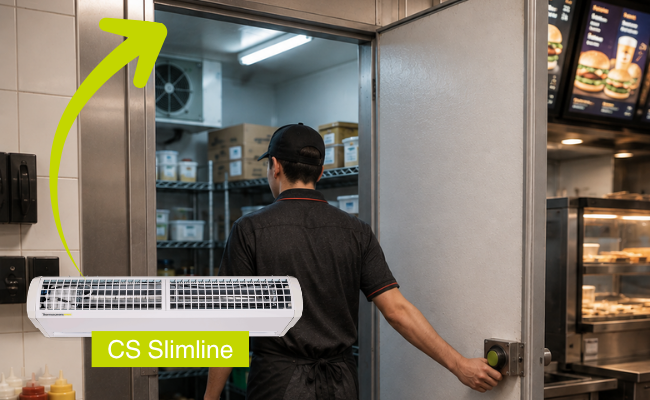
- Available headspace — where space above the door is limited, a compact unit such as the Thermoscreens Slimline Cold Store (SLCS) Air Curtain delivers full-strength performance in a slim profile.
- Control integration — door switches and BMS connectivity for automated, efficient operation.
The Thermoscreens cold chain range — including the Slimline CS and HX CS air curtains — is engineered specifically for these demanding, low-temperature environments, combining EC motor efficiency with built-in frost protection.
Explore the full range on the Thermoscreens Cold Store Air Curtain page and view real-world results in our cold storage case studies
Frequently Asked Questions
How do you stop ice forming in a cold store?
Stop ice at source by controlling the moisture and warm air that enter the space. The most effective combination is a cold store air curtain at the doorway, a correctly placed warm-side vapour barrier, well-maintained door seals, and disciplined door-open procedures. Desiccant dehumidification helps in high-humidity environments.
Why does my cold store doorway keep freezing over?
Doorways freeze because warm, humid air condenses and freezes on contact with cold surfaces every time the door opens. The fix is to reduce that air exchange — a frost-protected cold store air curtain creates a barrier that keeps warm, moist air out and cold air in.
Do air curtains really save energy in cold storage?
Yes. Independent studies and field data show air curtains can reduce doorway heat loss by up to 90% and cut refrigeration energy use by 20–40%. The energy saved through reduced refrigeration load and fewer defrost cycles substantially exceeds the energy the curtain consumes.
What temperature do I need a frost-protected air curtain?
Below -18°C you should always specify a dedicated low-temperature anti-frost model. Standard air curtains will freeze up and fail in freezer-room conditions.
Can an air curtain replace PVC strip curtains?
In most cases, yes. Air curtains provide unobstructed access, better hygiene and improved safety, and they remove the recurring cost and waste of replacing brittle plastic strips.
How quickly does a cold store air curtain pay for itself?
Because it targets the doorway, the largest single source of cold chain energy loss, a correctly specified and installed air curtain typically pays back within the first year through combined savings on energy, defrost, maintenance and product loss.
Take Control of Your Cold Store Environment
Condensation and ice build-up are not inevitable. With the right combination of vapour control, insulation, maintenance, operational discipline and — above all — effective climate separation at the doorway, you can protect your product, cut your energy bills, and keep your people safe.
The doorway is where the battle is won or lost. A purpose-built cold store air curtain is the most cost-effective place to start.
Ready to reduce condensation and ice in your facility?
Schedule a free site survey with the Thermoscreens team and let our cold chain specialists recommend the ideal air curtain solution for your operation , and show you exactly how much you could save.


Testimonials
“We’ve been very pleased with your products and would like to continue using them as a design feature in all our shops.”
- Project Manager, large ice-cream manufacturer.
“Wrapped up and gone before the lunch service, great turnaround from order to delivery.”
- Director, Restaurant in Aldwych
“Thank you for having an excellent working relationship with me, you are a credit to Thermoscreens.”
- Technical Engineer, HVAC
“The new air curtains in the freezer room have completely eliminated any ice and frost build up around the room, including the evaporators. As the main reason for cold room failure, this will undoubtedly help to reduce costly downtime, stock loss and maintenance calls.”
- Refrigeration Manager at leading supermarket
“The units we installed at Birmingham this week. We really enjoyed installing your units and would like to use them moving forward with the other stores.”
- Installer, Restaurant in Birmingham
“I would like to take this opportunity to thank you all for your performance, we have all been very impressed with your response to queries and turnaround of air curtains.”
- Installer, HVAC
“Thank you for all your support. We couldn’t have won this project without your assistance.”
- Senior engineer