How Much Energy Does an Open Cold Store Door Actually Waste?.
Every time a cold store door swings open, something expensive happens: carefully chilled or frozen air spills out, warm ambient air rushes in, and the refrigeration plant has to work overtime to put things right. For operators running cold storage warehouses, distribution centres, or retail cold rooms, cold store door energy loss isn’t a minor inefficiency — it’s one of the largest, most controllable costs in the entire refrigeration system.
This guide breaks down exactly how much energy an open cold store door wastes, what drives that loss, and the proven ways to stop it — including how a properly specified air curtain for cold store doors, such as the Thermoscreens Slimline CS Series, can cut door-related heat gain by up to 80%.
Why Does an Open Cold Store Door Waste So Much Energy?
Short answer: An open cold store door creates a temperature and pressure difference between two very different air masses — cold, dense air inside and warm, moist air outside — and physics does the rest. Cold air sinks and flows out along the floor while warm air pours in above it, a process engineers call convection or “air exchange.”
This isn’t a small effect. Industry data on refrigerated warehousing shows that convection-driven air exchange can account for as much as 85% of the total energy loss associated with door openings, making it by far the dominant factor — well ahead of conduction through the door panel itself.
Every time the door opens, the cold store effectively “breathes out” its refrigerated air and “breathes in” a warm, humid replacement. The refrigeration system then has to remove that heat and moisture all over again — burning electricity to re-cool air that was already cold minutes earlier.
How Much Energy Does an Open Cold Store Door Actually Waste?
Short answer: In high-traffic cold storage facilities, door-related heat gain can account for around 30% of total refrigeration load — and every degree of temperature swing at the doorway compounds the cost.
To put that in real terms: temperature recordings at unprotected cold store doorways commonly show a rise of between 4°C and 10°C each time the door is opened, as warm dock or ambient air mixes with the refrigerated air inside. In a busy facility with hundreds of door cycles a day — forklifts, pallet movements, staff access — those individual losses stack up into a continuous drain on the compressor, condenser, and evaporator, all of which are sized (and costing you money) to cope with that extra load.
The knock-on effects go beyond the electricity bill:
- Compressor wear and downtime from constantly having to recover lost capacity
- Product quality and shelf-life risk from temperature fluctuation at the door zone
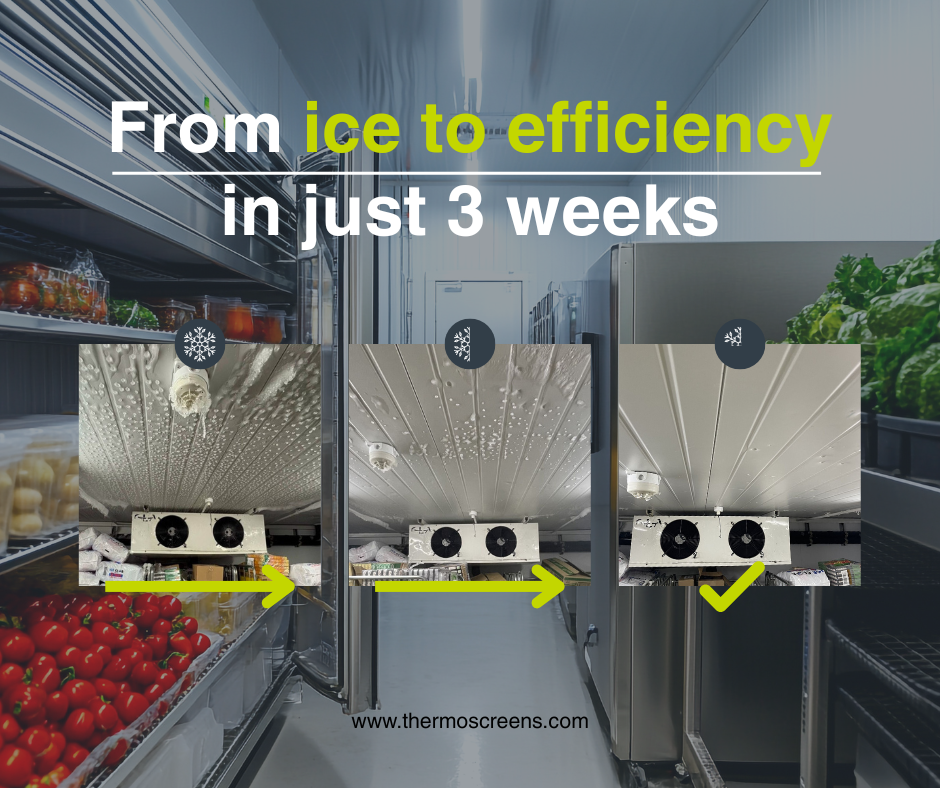
- Ice and frost build-up on evaporators and floors as warm, moist air condenses in the cold environment
- Higher carbon footprint, as refrigeration already accounts for a disproportionate share of a cold chain facility’s total energy use
What Factors Affect How Much Energy a Cold Store Door Wastes?
Not every doorway loses energy at the same rate. Several variables determine the true scale of the problem for a specific site:
- Door opening frequency — a distribution hub with constant pallet movement loses far more than a low-traffic storage room
- Door open/dwell time — the longer a door stays open, the more air exchange occurs; slow manual doors are a common culprit
- Temperature differential — the bigger the gap between inside and outside temperature (e.g. a -25°C blast freezer vs. an ambient loading bay), the faster and more forceful the air exchange
- Door size and design — larger openings and older, poorly sealed doors allow more air movement per opening
- Seal condition — degraded gaskets and worn seals let cold air leak out even when the door is fully closed, quietly adding to the load around the clock
- Absence of climate separation — a doorway with no strip curtain, fast door, or air curtain has nothing to resist the natural convection current at all
This is why a genuine energy audit looks at traffic patterns and seal condition alongside the headline “door open” statistic — the fix depends on which factor is driving the loss on your site.
How Does an Air Curtain Reduce Cold Store Door Energy Loss?
Short answer: An air curtain creates a high-velocity, uninterrupted stream of air across the full width of the doorway, forming an invisible aerodynamic barrier that resists the natural convection current — keeping cold air in and warm air out even while the door stands open for access.
Unlike strip curtains or heavy vestibules, an air curtain doesn’t physically obstruct movement, which matters in a cold store where forklifts, pump trucks, and staff need continuous, unhindered access. Instead, it uses a precisely engineered jet of air to counteract the pressure differential at the doorway, dramatically slowing the rate at which cold and warm air masses exchange.
The evidence for this is well established in building physics and refrigeration engineering literature:
- Peer-reviewed research into climate separation systems for cold storage entrances found that a properly specified air curtain can reduce heat gains and losses through the doorway by up to 80% compared with leaving the opening unprotected.
- Field data from operational cold stores shows that door-zone temperature rises of 4–10°C can be brought down to as little as 1°C once an effective air curtain is installed — corresponding to heat loss reductions of up to 90% in that immediate zone.
- Effectiveness is highly dependent on correct specification: studies note that jet velocity, angle, and installation width all need to be tuned to the doorway, since a poorly set-up unit can perform at a fraction of its potential.
That last point is critical. An air curtain isn’t a “fit and forget” commodity item — the wrong unit, or a correctly-chosen unit installed without proper commissioning, can significantly underperform. This is why working with a manufacturer that engineers, tests, and supports the product — rather than simply supplying a generic fan in a box — makes a measurable difference to the real-world energy saving achieved.
What Is the ROI of Installing an Air Curtain on a Cold Store Door?
Short answer: Most cold store air curtain installations pay for themselves through energy savings within a matter of months to a few years, depending on door traffic, temperature differential, and the age of the equipment being replaced or supplemented.
Because door-related heat gain is one of the largest controllable loads in a cold store, even a partial reduction translates into a meaningful drop in compressor run-time and electricity draw. When assessing the ROI of a cold store air curtain, operators should weigh up:
- Energy cost avoided — reduced refrigeration load directly lowers kWh consumption at the compressor
- Reduced maintenance and downtime — less thermal cycling means less strain on refrigeration components and fewer ice/frost-related callouts
- Product protection — fewer temperature excursions mean less risk of stock loss, spoilage, or quality non-conformance, particularly important for temperature-sensitive food, pharmaceutical, or biotech storage
- Operational continuity — because an air curtain doesn’t obstruct the opening, there’s no need to stop for manual doors or strip curtains, keeping throughput high while still protecting the environment inside
- Energy-efficient motor technology — modern EC motor-driven air curtains consume significantly less power to run than older AC motor units, improving the net saving
Because payback is so strongly linked to door traffic and temperature differential, the most reliable way to model ROI for a specific site is a proper site survey rather than a generic calculation — which is why Thermoscreens offers a free site survey as the first step for any cold store project.
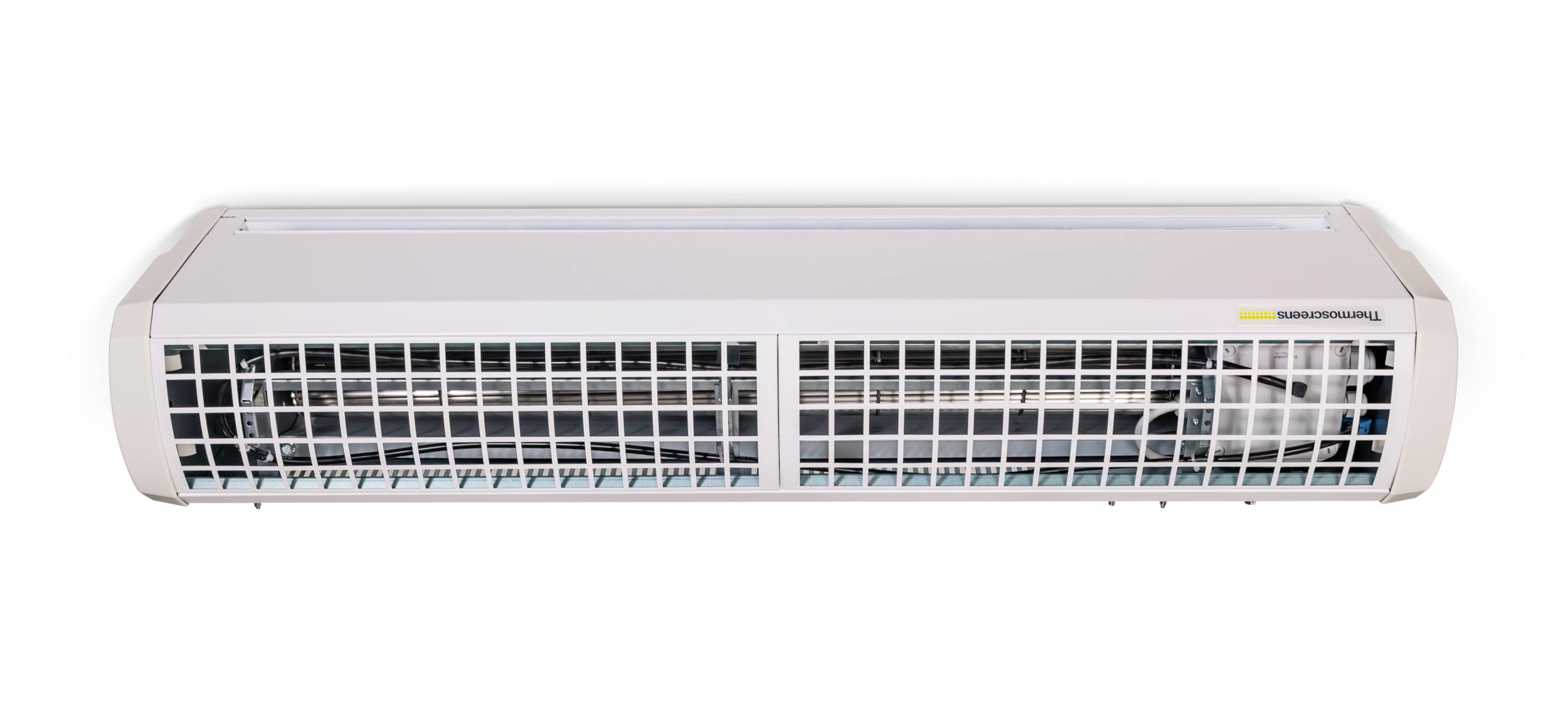
The Solution: Thermoscreens Slimline CS Series
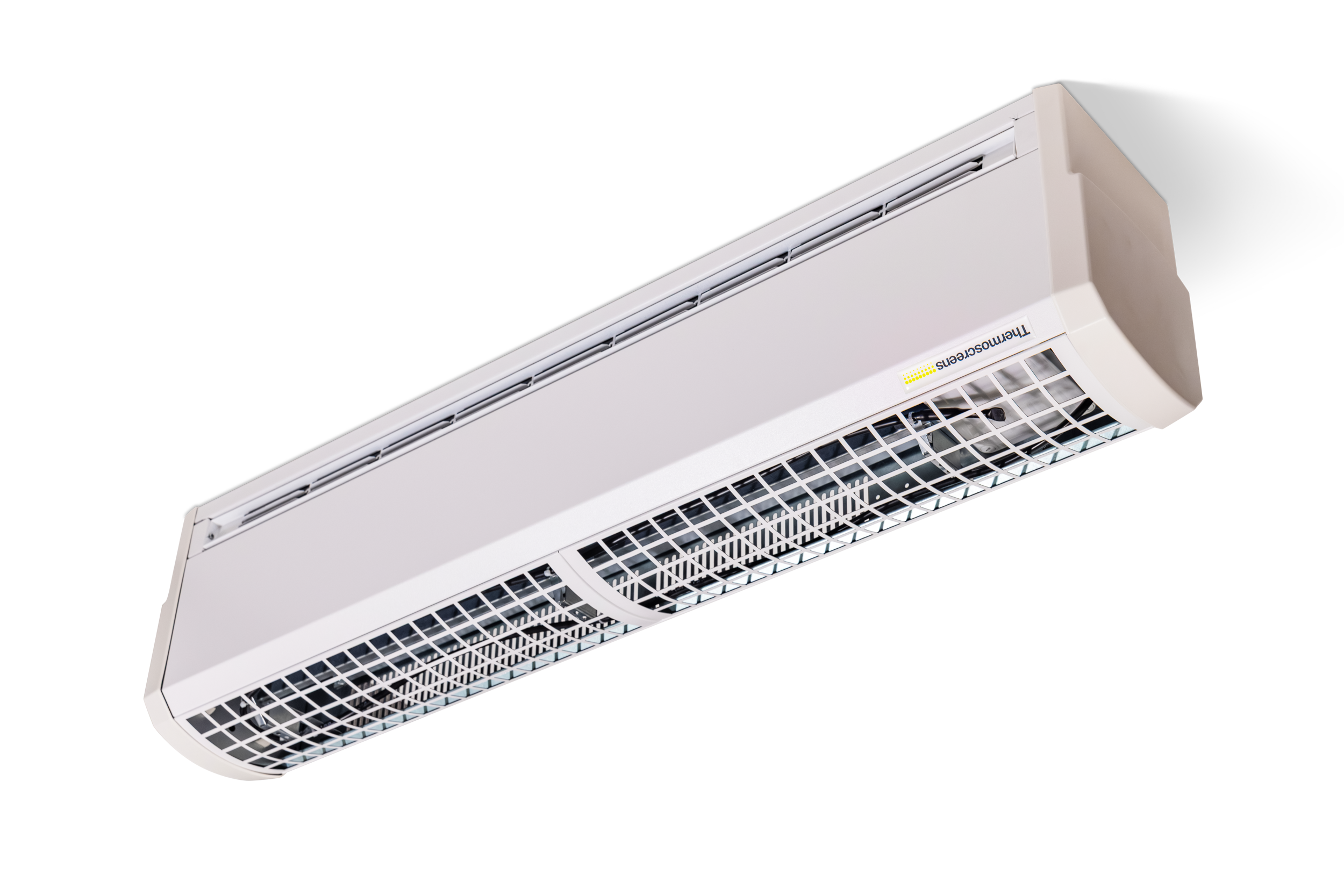
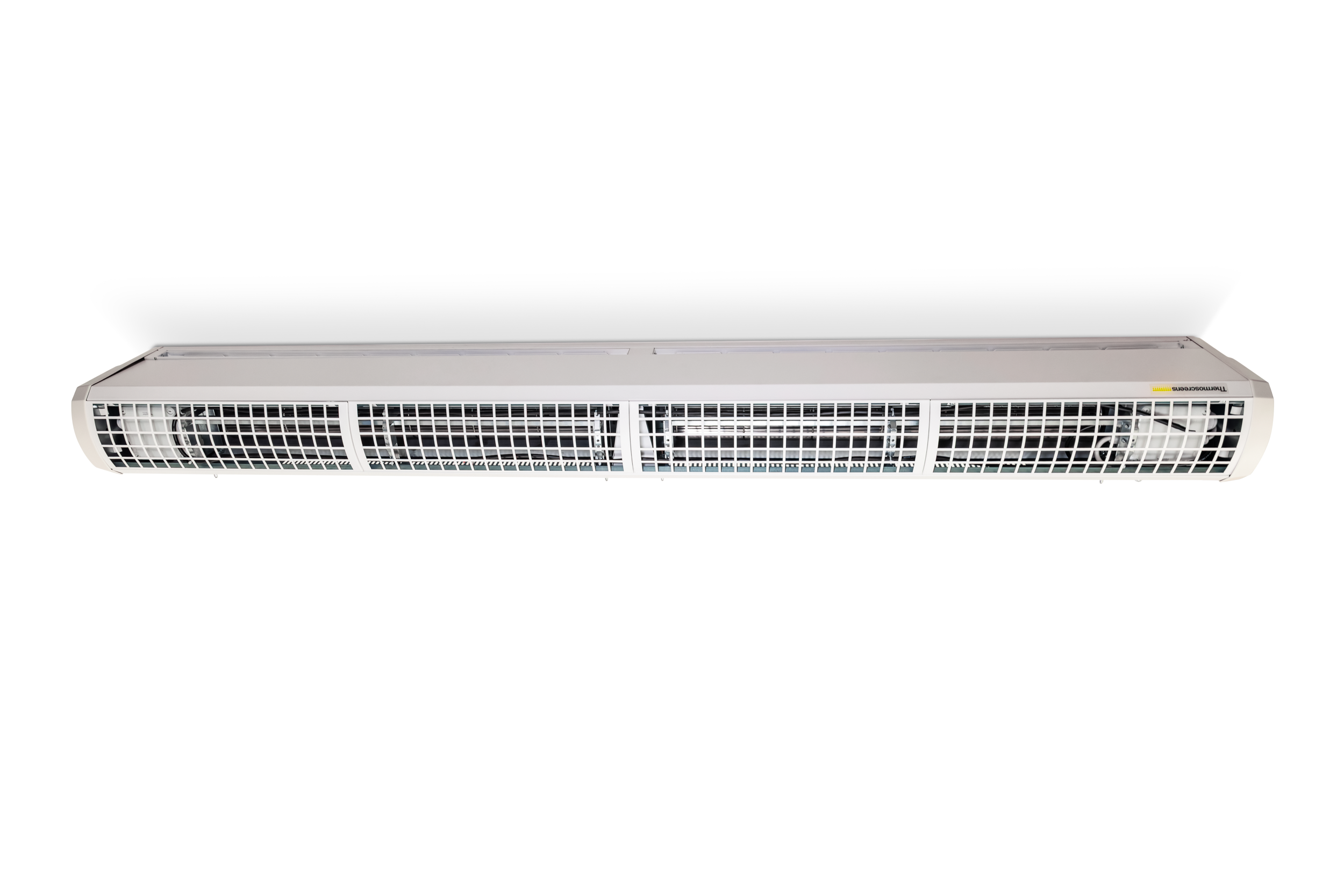
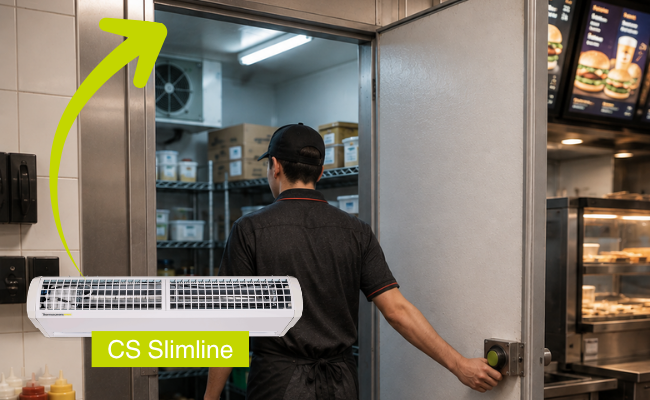
For cold stores where every degree — and every centimetre of headroom — counts, the Thermoscreens Slimline CS Series is engineered specifically to solve the cold store door energy loss problem without complicating the doorway.
Key capabilities of the Slimline CS Series:
- Engineered for sub-zero climate separation — maintains an effective air barrier in cold stores down to as low as -25°C
- Energy-efficient EC motor technology — keeps the cold store cold while minimising the electricity the air curtain itself consumes
- Built-in frost protection — prevents ice build-up on the unit so it keeps performing exactly when it’s needed most
- Enlarged inlet grille with integrated heating elements — eliminates ice accumulation at the intake, protecting long-term performance
- Unhindered access — removes the need for physical doors or strip curtains, so forklifts, pallet trucks, and staff move through without interruption or damage risk
- Compact, space-saving design — purpose-built for cold stores where headspace above the doorway is limited
- Horizontal and vertical configurations available to suit different doorway layouts and building constraints
In practice, this means a facility can stop expensive cold air escaping through the doorway — described directly in the product’s core benefit as significantly reducing energy costs by stopping the waste of expensive cold air — while keeping the door zone fully accessible for continuous operations.
For larger cold store openings or different site constraints, the wider CS Cold Store Air Curtain range offers additional configurations, and Thermoscreens’ cold storage sector expertise covers everything from blast freezers to multi-temperature distribution warehouses.
How to Reduce Cold Store Door Energy Loss: A Practical Checklist
If you’re assessing your own facility, start with these steps:
- Audit door traffic and dwell time at each doorway to identify the highest-loss points first
- Inspect seals and gaskets for wear, tears, or compression loss — even closed doors leak if seals are degraded
- Measure temperature swing at the doorway during normal operation to quantify the real-world impact
- Specify climate separation correctly for the temperature differential and door size — a generic or undersized air curtain will underperform
- Commission properly — jet velocity and angle need to be tuned to the specific doorway, not left at default settings
- Review regularly — traffic patterns, seasonal temperature swings, and equipment wear all change the picture over time
Thermoscreens’ case studies and blog library cover further detail on related topics, including strip curtains vs. air curtains, ice build-up prevention, and condensation control in cold storage environments.
Frequently Asked Questions
How much energy does an open cold store door waste? Door-related heat gain can account for around 30% of total refrigeration load in high-traffic cold storage facilities, driven mainly by convection — the exchange of cold and warm air masses — which is responsible for up to 85% of the energy loss at an open doorway.
What causes most of the energy loss at a cold store door? Convection (air exchange) is the dominant cause, not conduction through the door panel. Every opening allows cold, dense air to flow out along the floor while warm, humid air flows in above it, and the refrigeration system has to remove that heat all over again.
Do air curtains actually work on cold store doors? Yes. Independent research and field data show properly specified and commissioned air curtains can reduce heat gain and loss through a cold store doorway by up to 80–90%, provided jet velocity, angle, and installation width are correctly matched to the opening.
What is the payback period for a cold store air curtain? Payback varies by site but is typically measured in months to a few years, depending on door traffic frequency, the temperature differential being protected, and the efficiency of the unit installed. A site survey gives the most accurate estimate for a specific facility.
Can an air curtain replace a cold store door entirely? In many applications, yes — a correctly specified air curtain, such as the Thermoscreens Slimline CS Series, can remove the need for a physical door or strip curtain altogether, maintaining climate separation while keeping the opening fully clear for continuous access.
Is the Thermoscreens Slimline CS Series suitable for very low temperatures? Yes. It is designed and engineered to maintain climate separation in cold stores with temperatures as low as -25°C, with built-in frost protection and a heated inlet grille to prevent ice build-up.
Talk to Thermoscreens About Your Cold Store
If cold air is escaping through your doorways every day, the cost is already showing up on your energy bill — you just haven’t seen it broken out yet. Thermoscreens’ team can assess your specific door traffic, temperature differential, and layout, then recommend the right climate separation solution for your site.
Book a free site survey or request a quote to find out exactly how much your open cold store doors are costing you — and how quickly a Slimline CS Series air curtain could pay for itself.

Testimonials
“We’ve been very pleased with your products and would like to continue using them as a design feature in all our shops.”
- Project Manager, large ice-cream manufacturer.
“Wrapped up and gone before the lunch service, great turnaround from order to delivery.”
- Director, Restaurant in Aldwych
“Thank you for having an excellent working relationship with me, you are a credit to Thermoscreens.”
- Technical Engineer, HVAC
“The new air curtains in the freezer room have completely eliminated any ice and frost build up around the room, including the evaporators. As the main reason for cold room failure, this will undoubtedly help to reduce costly downtime, stock loss and maintenance calls.”
- Refrigeration Manager at leading supermarket
“The units we installed at Birmingham this week. We really enjoyed installing your units and would like to use them moving forward with the other stores.”
- Installer, Restaurant in Birmingham
“I would like to take this opportunity to thank you all for your performance, we have all been very impressed with your response to queries and turnaround of air curtains.”
- Installer, HVAC
“Thank you for all your support. We couldn’t have won this project without your assistance.”
- Senior engineer