Ice Build-Up in Cruise Ship Cold Rooms: Causes, Costs and Solutions.

Ice build-up in cold rooms is one of the most persistent – and most expensive – problems facing cruise ship galleys and provisions stores today. Every time a crew member opens a cold store door to retrieve stock, warm, moisture-laden air rushes in, condenses on cold surfaces, and freezes. Over weeks at sea, that frost turns into thick ice on floors, walls and evaporator coils, driving up energy consumption, slowing food service, and creating real slip-and-fall hazards for crew.
For cruise operators, this isn’t a minor housekeeping issue. With provisions stores opened hundreds of times a day across multiple decks, ice accumulation directly affects cruise ship cold storage performance, refrigeration maintenance budgets, and compliance with international food safety standards. This guide breaks down exactly why ice forms in marine cold rooms, what it actually costs a vessel over a season, and how air curtains for cold storage are helping cruise lines solve the problem at the source, the open doorway.
Why Does Ice Build-Up Happen in Cold Rooms? (The Science, Simplified)
Short answer: Ice forms when warm, humid air meets a cold surface and the moisture in that air freezes on contact. On a cruise ship, this happens every time a cold store door opens.
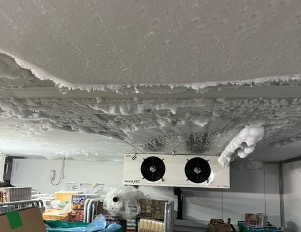
Cold rooms are kept at temperatures well below the dew point of the surrounding air. When a door opens, even briefly – humid galley or corridor air is pulled into the cold space. The moisture in that air can’t stay as vapour at sub-zero temperatures, so it condenses and then freezes, forming:
- Frost and ice on floors, creating slip hazards for crew moving trolleys and stock
- Ice sheeting on walls and door frames, which can prevent doors from sealing properly
- Frost accumulation on evaporator coils, which is the most damaging outcome of all
Evaporator icing is particularly serious because it insulates the coil, reducing heat transfer efficiency. The refrigeration system then has to run longer and harder to hit the same set-point, which accelerates compressor wear and increases the frequency of defrost cycles.
What Makes Cruise Ships Especially Prone to Cold Room Ice Build-Up?
Cruise ships face a combination of operational pressures that make ice accumulation worse than in a typical shore-based cold store:
- High door-opening frequency — galleys, provisions stores and pantries are accessed continuously across breakfast, lunch, dinner and room service cycles, often on multiple decks simultaneously.
- Variable ambient conditions — humid tropical itineraries and enclosed, poorly ventilated service corridors increase the moisture content of the air entering cold stores.
- Space and access constraints — narrow doorways and tight service routes mean doors are frequently propped open during busy restocking periods, extending infiltration time.
- Continuous operation — unlike a retail cold store that closes overnight, cruise ship provisions areas are in near-constant use across a multi-day or multi-week voyage, giving ice far more opportunity to accumulate before it can be addressed.
Industry research into refrigerated storage backs this up at a broader level: studies referenced by the U.S. Department of Energy and ASHRAE have found that door infiltration can account for more than half of the total refrigeration load in high-traffic cold rooms — meaning the door, not the compressor, is often the biggest source of inefficiency. On a vessel with dozens of cold stores in continuous use, that inefficiency compounds fast.
What Does Ice Build-Up Actually Cost a Cruise Operator?
Short answer: Ice build-up costs operators in four areas simultaneously — energy, maintenance, safety, and food compliance risk — and these costs compound the longer the problem is left unaddressed.
1. Higher energy consumption
Ice-covered evaporator coils lose heat exchange efficiency, forcing refrigeration compressors to run for longer periods to maintain set temperature. On a vessel with dozens of cold stores, this adds a continuous, cumulative drain on the ship’s energy budget — a critical concern as fuel and power costs rise and IMO efficiency regulations tighten.
2. Increased maintenance and defrost downtime
Heavy ice accumulation requires more frequent manual or automatic defrost cycles, each of which temporarily takes the cold room out of full operation. Left unmanaged, ice can also damage door seals, sensors and evaporator fins, shortening equipment lifespan and increasing unplanned maintenance callouts — a costly proposition mid-voyage, far from a shore-based technician.
3. Crew safety risk
Ice on cold store floors is a leading contributor to slip-and-trip incidents in galley and provisions areas — a documented workplace hazard in food service environments generally, and one that carries particular weight on board a vessel where crew move quickly between service areas.
4. Food safety and compliance exposure
Cruise ship cold storage is subject to rigorous inspection regimes, including the CDC’s Vessel Sanitation Program (VSP), which conducts unannounced inspections against public health standards covering food storage temperatures. Temperature instability caused by inefficient, ice-laden refrigeration systems increases the risk of deviations that can affect inspection outcomes and, more importantly, food quality and passenger health.
How Do You Prevent Ice Build-Up in Cold Rooms?
Short answer: The most effective way to prevent ice build-up is to stop warm, humid air from entering the cold room in the first place — which means controlling what happens at the doorway, not just treating the symptoms afterward.
Traditional approaches to this problem fall short in a marine environment:
- Strip curtains provide a physical barrier but degrade quickly in high-traffic conditions, often get pushed aside or left open by trolleys, and can themselves become a hygiene and ice-accumulation point. (We’ve covered this trade-off in detail in Why Strip Curtains Could Be Costing Your Cold Store Thousands.)
- Faster-closing physical doors reduce exposure time but don’t eliminate infiltration during the (often lengthy) periods when the door needs to stay open for restocking.
- Manual defrost schedules treat the ice after it has already formed, rather than preventing it — an ongoing labour cost rather than a fix.
The more effective long-term strategy is climate separation at the doorway — using a controlled barrier that keeps cold air in and warm, moist air out, without restricting crew access. This is where air curtain technology has become the standard recommendation across cold chain and refrigeration engineering, a shift we explore further in Every Open Door Is a Leak: The Business Case for Air Curtains in Cold Storage.
How Do Air Curtains Prevent Ice Build-Up in Cold Storage?
Short answer: An air curtain creates a high-velocity, uninterrupted stream of air across an open doorway, forming an invisible barrier that separates two different climates without a physical door.
Unlike strip curtains or sliding doors, a properly specified cold chain air curtain:
- Projects a laminar jet of air from ceiling to floor (or across a horizontal opening) that resists penetration from ambient air currents
- Prevents warm, humid air from crossing into the cold room even while the doorway is open
- Reduces the moisture ingress that causes frost and ice to form on floors, walls and evaporator coils
- Eases the workload on refrigeration compressors, lowering both energy consumption and long-term wear
- Allows staff, trolleys and pallets to pass through freely, with no obstruction and no risk of the barrier being propped open
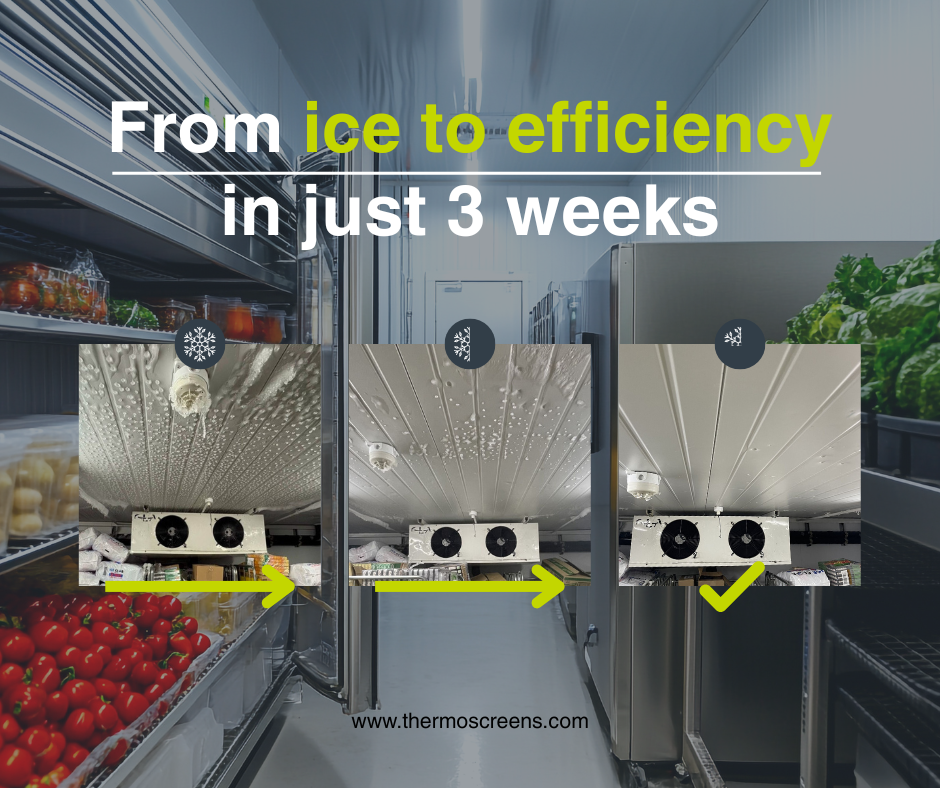
Thermoscreens has documented this effect directly in the field: one refrigeration manager reported that installing air curtains in a freezer room “completely eliminated any ice and frost build-up around the room, including the evaporators” — addressing what is widely regarded as the leading cause of cold room refrigeration failure.
For a deeper technical breakdown of what separates an effective unit from an underperforming one, see What Makes an Air Curtain High Performance? Key Specification Factors.
What Is the ROI of Installing Air Curtains in Cruise Ship Cold Rooms?
Short answer: Air curtains typically pay for themselves through reduced energy consumption and lower maintenance spend, with many cold storage operators reporting payback within one to three years depending on door traffic and ambient conditions.
The return on investment comes from several compounding sources:
- Lower refrigeration energy use, since compressors no longer have to compensate for constant warm-air infiltration
- Reduced defrost frequency, cutting both energy spend and the labour time associated with manual ice removal
- Extended equipment lifespan, as evaporators and compressors run under more stable, less strained conditions
- Fewer maintenance callouts, particularly valuable on a vessel where an engineer visit may not be possible until the next port
- Reduced food spoilage risk, protecting stock value and supporting consistent VSP and food safety compliance
Because cold chain infiltration losses scale directly with door-opening frequency, cruise ship provisions areas — among the highest-traffic cold storage environments in any industry – tend to see some of the fastest payback periods of any commercial cold storage application.
Thermoscreens Cold Chain Air Curtain Range for Marine Applications
Thermoscreens supplies a dedicated range of cold chain air curtains engineered for different refrigerated environments on board:
| Model | Operating Temperature | Best Suited To |
|---|---|---|
| CS (Cold Stores) Air Curtain | Down to -25°C | Deep freeze provisions stores requiring maximum thermal separation |
| HE (Harsh Environments) Air Curtain | Approx. 2°C | Food preparation areas needing stainless steel construction and resistance to chemical cleaning agents |
| RA (Refrigerated Areas) Air Curtain | Down to 0°C (non-condensing) | Chilled goods storage with frequent access |
Each model is designed to reduce moisture ingress, stabilise internal temperatures, and ease pressure on the ship’s refrigeration systems — read the full breakdown in Addressing Cold Chain Challenges in the Cruise Industry or explore the complete Cold Storage range.
Frequently Asked Questions
What causes ice build-up in a cold room?
Ice build-up is caused by warm, moisture-laden air entering a cold room — usually through an open door — and condensing then freezing on cold surfaces such as floors, walls and evaporator coils. The more frequently a door is opened, the more moisture enters and the faster ice accumulates.
How does ice build-up affect refrigeration efficiency?
Ice insulates evaporator coils, reducing their ability to transfer heat effectively. This forces the refrigeration system to run longer and harder to maintain temperature, increasing energy consumption and accelerating compressor wear.
Can air curtains completely stop ice build-up in cold rooms?
Air curtains significantly reduce ice build-up by preventing the warm, humid air that causes it from entering the cold room in the first place. Correctly specified and installed units have been reported to virtually eliminate frost and ice accumulation, including on evaporator coils, in high-traffic cold storage environments.
Are air curtains better than strip curtains for cold storage doors?
For high-traffic environments like cruise ship provisions stores, air curtains generally outperform strip curtains because they don’t degrade with heavy use, can’t be propped open, and don’t themselves become a hygiene or ice-accumulation risk. Strip curtains provide a physical barrier, but one that’s easily compromised in constant-access environments.
How cold can a Thermoscreens cold chain air curtain operate?
The Thermoscreens CS (Cold Stores) Air Curtain is designed to operate effectively in temperatures as low as -25°C, making it suitable for deep-freeze provisions stores. The RA and HE models are designed for refrigerated (0°C to approximately 2°C) applications.
What are the food safety implications of ice build-up on cruise ships?
Ice build-up is a symptom of temperature instability, which can increase the risk of deviations during cold storage inspections, including those conducted under the CDC’s Vessel Sanitation Program. Stable, well-controlled cold storage temperatures are essential to protecting both food quality and inspection outcomes.
Take the Next Step Toward Ice-Free, Efficient Cold Storage
Ice build-up in cold rooms isn’t an inevitable cost of doing business at sea — it’s a solvable engineering problem. If your cruise ship’s provisions stores are dealing with frost accumulation, rising refrigeration energy costs, or recurring maintenance callouts, a correctly specified cold chain air curtain can address the issue at its source.
Book a free site survey with the Thermoscreens team to get a tailored recommendation for your vessel’s cold storage doorways, or contact our sales team to discuss your cold chain challenges directly.




Testimonials
“We’ve been very pleased with your products and would like to continue using them as a design feature in all our shops.”
- Project Manager, large ice-cream manufacturer.
“Wrapped up and gone before the lunch service, great turnaround from order to delivery.”
- Director, Restaurant in Aldwych
“Thank you for having an excellent working relationship with me, you are a credit to Thermoscreens.”
- Technical Engineer, HVAC
“The new air curtains in the freezer room have completely eliminated any ice and frost build up around the room, including the evaporators. As the main reason for cold room failure, this will undoubtedly help to reduce costly downtime, stock loss and maintenance calls.”
- Refrigeration Manager at leading supermarket
“The units we installed at Birmingham this week. We really enjoyed installing your units and would like to use them moving forward with the other stores.”
- Installer, Restaurant in Birmingham
“I would like to take this opportunity to thank you all for your performance, we have all been very impressed with your response to queries and turnaround of air curtains.”
- Installer, HVAC
“Thank you for all your support. We couldn’t have won this project without your assistance.”
- Senior engineer